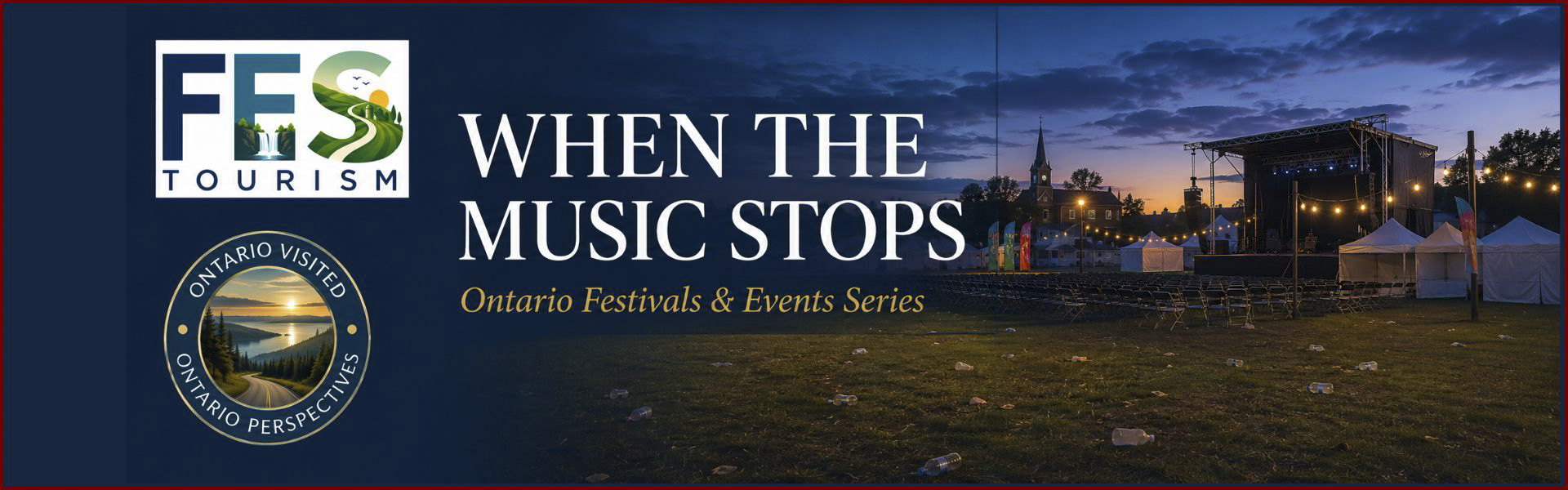

















WHEN THE MUSIC STOPS
“The Fight to Save Ontario’s Festivals and Events”
PART ONE OF TEN
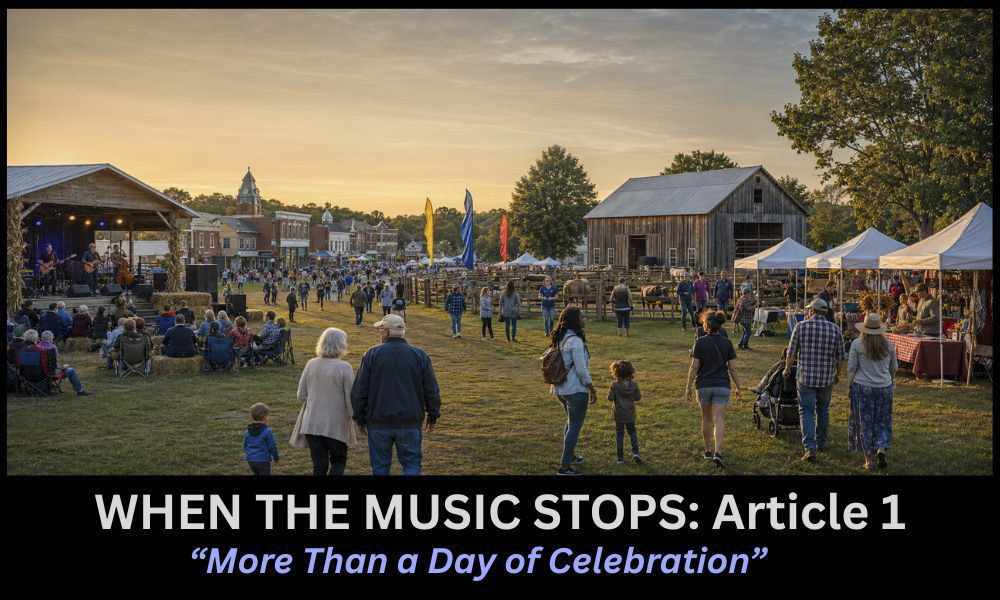
MORE THAN A DAY OF CELEBRATION
“Why Ontario’s Festivals and Events Matter More Than We Realize”
Ontario Perspectives • Special Investigative Series
EXECUTIVE SUMMARY
Ontario’s festivals and events are much more than entertaining ways to spend a summer afternoon, a holiday weekend or a crisp autumn day. They are gathering places where communities celebrate their identity, preserve their traditions, welcome visitors and introduce one generation to the next.
They also generate spending for restaurants, accommodations, retailers, gas stations, vendors, artists and local suppliers. They create opportunities for volunteers to develop skills, confidence and leadership experience. They provide stages for performers, marketplaces for producers and reasons for visitors to discover communities they might otherwise pass by.
Yet behind the music, midway lights, parades and crowded Main Streets, many Ontario events are becoming increasingly vulnerable. Government funding is competitive and uncertain. Corporate sponsorship is changing. Production costs and insurance requirements are rising. Regulations are becoming more complicated. Experienced volunteers are aging, exhausted and increasingly difficult to replace. Severe weather, wildfire smoke and unstable access to event lands add even more uncertainty.
The closure of Festivals and Events Ontario after approximately 30 years of provincial service should be understood as a warning. If Ontario does not recognize festivals and events as essential community infrastructure, some will quietly disappear—and the full extent of what has been lost may not become clear until it is too late.
ABOUT THIS SERIES
When the Music Stops is a ten-part FES Tourism special series examining the pressures confronting Ontario’s festivals and events. From funding, insurance and regulations to volunteers, weather, land use and the loss of Festivals and Events Ontario, the series explores what is at risk—and what governments, businesses, organizers and communities can do to protect the celebrations that help define Ontario.
WHEN A COMMUNITY COMES TOGETHER
The grounds are quiet in the early morning.
Volunteers arrive while dew still covers the grass. Tents are opened, tables unfolded and signs carefully placed. Vendors unload their products. Performers test microphones. Food begins cooking. Livestock is settled into barns. Barricades are checked, admission gates prepared and last-minute questions answered.
Within a few hours, the silence will be replaced by music, conversation and laughter.
Children will race toward the midway. Families will walk between agricultural displays. Visitors will discover the work of local artists, farmers, craftspeople and food producers. Old friends will meet unexpectedly. Former residents will return home. Newcomers will begin to understand what makes their adopted community special.
Most visitors will never see the months of planning that made the day possible. They will not see the late-night committee meetings, unanswered sponsorship letters, grant applications, insurance negotiations, site plans, permit approvals, volunteer schedules or anxious hours spent watching the weather.
They will simply know that something is happening—and that, for this day or weekend, the community feels alive.
That is the quiet power of an Ontario festival or event.
THE HEARTBEAT OF A COMMUNITY
Festivals are sometimes treated as optional entertainment: pleasant to have when money and volunteers are available, but not essential to the life of a community.
That seriously underestimates their importance.
An arena provides a place to play. A library provides a place to learn. A park provides a place to gather. Festivals and events bring all of those community functions together. They use public and private spaces to create experiences in which residents can participate, contribute, celebrate and belong.
A fall fair tells the story of agriculture and rural life. A cultural festival allows people to share their traditions with neighbours. A heritage celebration keeps local history from becoming merely a plaque on a wall. A music or arts festival gives performers and creators an audience. A parade turns familiar streets into shared public space. A community festival introduces visitors to the character of a town.
Ontario’s events are as varied as the province itself:
- Agricultural fairs and livestock exhibitions
- Music and arts festivals
- Cultural and heritage celebrations
- Indigenous gatherings
- Food and agricultural events
- Farmers’ markets
- Busker festivals
- Winter carnivals
- Canada Day celebrations
- Historical re-enactments
- Community homecomings
- Main Street festivals
- Holiday parades
- Rural and northern community celebrations
Each tells part of Ontario’s story.
DOLLARS THAT TRAVEL THROUGH THE COMMUNITY
The economic contribution begins long before the gates open.
Organizers purchase advertising, printing, equipment rentals, insurance and professional services. They hire entertainers, technicians, security personnel and contractors. Vendors purchase ingredients, products and supplies. Visitors buy fuel, meals, accommodations and merchandise.
The money rarely stops at the event grounds.
A family attending a festival may eat at a local restaurant, purchase something from a Main Street store, visit a nearby attraction or decide to return for a longer stay. An artist may gain a new customer. A food producer may be introduced to hundreds of potential buyers. A small business may receive more exposure in one festival weekend than it could afford to purchase through conventional advertising.
An Ontario study of 97 cultural, sport, recreation and community events found that their combined activity contributed nearly $80 million to provincial GDP, more than $30 million in taxes, approximately 2,600 jobs and over $50 million in wages and salaries.
That research is now dated and should not be treated as the present-day value of Ontario’s entire event industry. However, it demonstrates something important: even a limited group of events can produce meaningful economic activity throughout the province.
In 2024, visitors to Ontario spent approximately $33 billion and supported more than 300,000 jobs. Festivals and events are among the experiences that encourage those visitors to explore Ontario’s cities, towns, rural communities and northern regions.
A crowded festival does not automatically mean that its organizer is financially secure. The restaurants, hotels, vendors and surrounding businesses may benefit even when the organization producing the event barely breaks even—or loses money.
That contradiction will become increasingly important throughout this series.
WHERE FUTURE LEADERS BEGIN
Some of the greatest benefits of festivals cannot be measured at an admission gate.
A teenager begins by helping with parking or cleaning tables. Later, that volunteer becomes a team leader, joins a committee, learns to prepare a budget, speaks to municipal council, approaches a sponsor or supervises other volunteers.
Those experiences build confidence and practical ability.
Festival and event organizations teach people how to:
- Work as part of a team
- Accept responsibility
- Manage money
- Solve unexpected problems
- Speak publicly
- Negotiate
- Recruit and motivate others
- Cooperate with businesses and governments
- Make difficult decisions
- Lead
Some of Ontario’s future business owners, service-club members, nonprofit directors and municipal leaders will receive their first real leadership experience while volunteering for a community event.
When an event disappears, a community therefore loses more than a celebration. It can lose one of its most effective and accessible leadership-development programs.
A VIEW FROM THE FESTIVAL ROAD
Over decades of organizing, judging, promoting and visiting festivals and events, Judi and I have seen what these celebrations mean to Ontario communities.
I have also experienced the difference between an event that becomes deeply connected to its community and one that struggles to establish those roots.
The Cobourg Waterfront Festival began as something new. Cobourg did not possess a particular historical connection to arts and crafts, yet the event grew into an important community celebration.
The Farini Festival in Port Hope had precisely the kind of local connection that would seem to promise success. William Leonard Hunt—the Great Farini—grew up in the area, practised his early tightrope walking across local buildings, died in Port Hope and is buried in its cemetery. Yet the festival was organized quickly and ended after three years.
Those experiences taught me that a good theme, a famous name or an attractive program cannot guarantee an event’s future. Long-term success requires community acceptance, careful planning, dependable leadership, financial support, partnerships and time.
An event survives when enough people decide it belongs to them.
THE WARNING SIGNS ARE BECOMING HARDER TO IGNORE
Ontario’s festivals and events are now facing several pressures at the same time.
Government assistance remains available, but much of it is competitive and uncertain. Corporate sponsors are reconsidering expenditures and increasingly expect measurable returns. Municipal requirements can involve multiple departments, permits, fees and professional plans.
Insurance costs and liability requirements have increased. Equipment, entertainment, security, washrooms, waste removal and technical services are more expensive.
Weather is no longer a matter of simply hoping it does not rain. Organizers must prepare for extreme heat, lightning, high winds, flooding, wildfire smoke and dangerous air quality.
Most importantly, the number of people willing to carry year-round responsibility is declining. An event may still find volunteers to work a four-hour shift, yet be unable to find someone prepared to become chair, treasurer, sponsorship director or operations manager.
In 2025, Sudbury Graphic-Con and Capreol Days were cancelled because of a shortage of volunteer organizers. Tottenham Community Week, a popular celebration that had attracted thousands of residents and visitors, was also cancelled because it lacked board members and event leaders.
These are not isolated inconveniences. They are indications of a weakening foundation.
WHEN THE PROVINCIAL VOICE DISAPPEARED
The closure of Festivals and Events Ontario gives this discussion additional urgency.
For approximately 30 years, FEO provided conferences, professional development, networking, resources, awards, industry recognition and the Top 100 Festivals and Events program. It helped create a collective identity for a diverse sector extending across the province.
Its closure left a significant gap.
We will examine FEO’s history and loss in detail later in this series. For now, its disappearance raises an uncomfortable question:
If the provincial organization created to support and strengthen festivals and events could not continue, what does that tell us about the condition of the organizations it served?
The closure should not be used to declare the industry defeated. It should be treated as a warning that Ontario’s existing system of event support may no longer be adequate.
REASONS FOR HOPE
The challenges are real, but this is not the end of Ontario’s festival story.
People still want to gather. Communities still take pride in their traditions. Visitors still search for authentic local experiences. Volunteers still want to contribute when they are offered meaningful, manageable and appreciated roles.
The Ontario government invested more than $20 million through Experience Ontario 2026 to support nearly 400 festivals and events. Municipalities continue to provide parks, services, grants and staff assistance. Businesses continue to sponsor local celebrations. Agricultural societies, service clubs, cultural organizations and community committees continue to accomplish remarkable things with limited resources.
Technology is making some administrative work easier. New approaches to volunteer recruitment are possible. Events are improving accessibility, environmental practices and emergency planning. Some organizations are successfully developing younger leaders and more diversified revenue.
Ontario does not lack ideas, audiences, traditions or community spirit.
What it lacks is a coordinated, long-term system that recognizes festivals and events as essential community infrastructure.
KEEPING THE CELEBRATION ALIVE
Saving Ontario’s festivals will require more than increasing one government grant or recruiting a few additional volunteers.
It will require:
- More dependable, multi-year funding
- Stronger municipal partnerships
- Greater consistency in regulatory processes
- More accessible insurance options
- Secure access to fairgrounds and event spaces
- Corporate sponsorship viewed as community investment
- Intentional volunteer leadership development
- Responsible succession planning
- Professional assistance for increasingly technical work
- Better measurement of economic and social contributions
- A renewed provincial voice for the sector
- Greater public recognition of the people behind every event
Event organizations must also be willing to change. Not every event needs to grow. Some may need to become smaller, shorten their duration, share resources, change venues, collaborate with neighbouring events or return to the original purpose that made them special.
Sustainability does not mean preserving every festival exactly as it has always been. It means protecting its heart while building an organization capable of carrying it into the future.
BEFORE THE MUSIC STOPS
Imagine an Ontario without its fall fairs, cultural festivals, parades, rural exhibitions, outdoor concerts, heritage celebrations and community homecomings.
The economic loss would be substantial. But the deeper loss would be found in quieter places: the tradition no longer passed to a child, the artist without a local stage, the business without its busiest weekend, the volunteer who never discovers the ability to lead and the community that has lost one of the occasions when it sees itself gathered in one place.
Festivals do not continue simply because they have existed for 20, 50 or 150 years.
They continue because each generation decides they are worth the work.
Ontario still has time to make that decision—but the warning signs tell us that it cannot be postponed indefinitely.
COMING IN PART TWO
Government grants and corporate sponsorship help bring Ontario’s festivals to life, but neither provides the certainty organizers need to plan confidently for the future.
In Part Two, The Financial Ground Is Shifting, we examine government assistance, declining sponsorship, short-term funding, cash-flow pressures and why even a crowded, successful event may be standing on financially fragile ground.
EXPLORE THE SERIES
Series Home: When the Music Stops — Coming Soon
Previous Article: This is Part One of the series.
Next Article: Part Two — The Financial Ground Is Shifting — Coming Soon
Published by FES Tourism, operating as Ontario Visited and Ontario Agritourism.