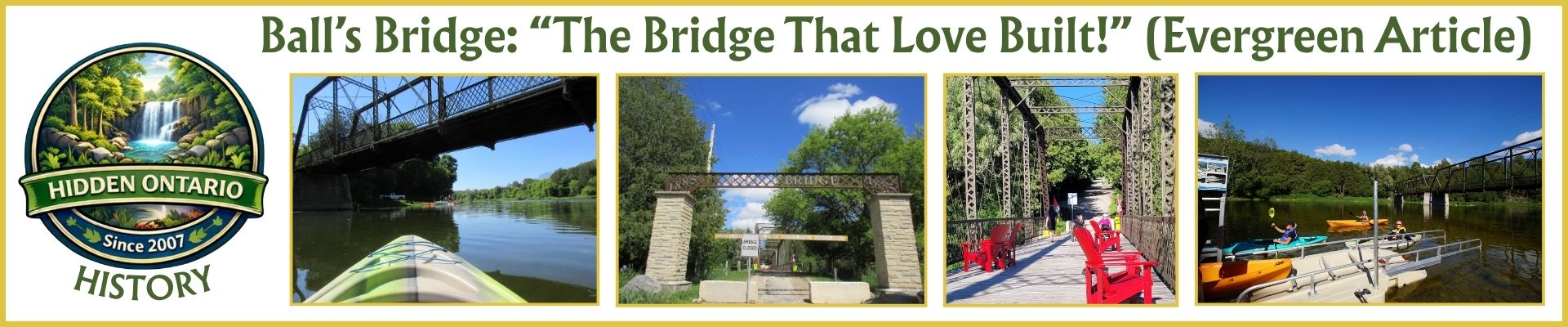



















Hidden among the forests and winding roads of Huron County stands one of Ontario’s most romantic landmarks. Crossing the Maitland River, Ball’s Bridge is far more than an impressive piece of 19th-century engineering—it’s a place where history, heritage, and legend come together.

Known affectionately as “The Bridge That Love Built,” Ball’s Bridge has connected communities, inspired countless photographs, and become the backdrop for proposals, weddings, and family traditions for nearly 140 years. Whether the famous love story is entirely fact or partly folklore, it has become an enduring part of the bridge’s identity.


Visitor Experience

📍 Location Little Lakes Road, Central Huron (near Goderich), Ontario
📅 Best Season Spring through Fall • Spectacular autumn colours
⏰ Hours Open year-round for pedestrians
💲 Admission Free
♿ Accessibility Pedestrian access only; surface and approaches may vary
🅿️🚻 Amenities Limited roadside parking • Scenic viewpoints
🕒 Recommended Time 30–60 minutes
🌐 Nearby Information Tourism Central Huron

What You Need to Know

Ball’s Bridge is located approximately nine kilometres east of Goderich along picturesque Little Lakes Road. Built in 1885, the bridge is one of Ontario’s finest surviving examples of a two-span Pratt through-truss bridge constructed of wrought iron with distinctive pin-connected engineering and decorative V-lacing. It was designated a provincial heritage site in recognition of its historical and engineering significance.

Today, the bridge is preserved as a pedestrian-only crossing, allowing visitors to appreciate both its remarkable craftsmanship and the tranquil beauty of the Maitland River valley. Recent decisions to close it to vehicle traffic were made to help protect the historic structure for future generations.

Why This Place Matters

When Ball’s Bridge was completed in 1885, it created an important transportation link between Goderich and the farming communities east of the Maitland River. Farmers, merchants, schoolchildren, and travellers all depended upon the crossing.

But over time, another story began to overshadow its engineering.

According to local tradition, a young woman from the Ball family regularly crossed the river on foot to travel into Goderich. During one journey she met an engineer supervising another bridge project. The two fell in love, and the engineer is said to have built Ball’s Bridge so she would never again have to wade across the river.

Whether every detail is historically documented or not, the story has been passed from generation to generation, earning Ball’s Bridge its enduring nickname: “The Bridge That Love Built.” (Municipality of Central Huron)

Fun Fact:

At 251 feet (77.4 metres) long, Ball’s Bridge remains one of Ontario’s rare surviving wrought-iron Pratt through-truss bridges, making it as significant to engineering history as it is to local folklore. (Stops Along the Way)


Journey Through Time

  • 1820s: Settlement begins throughout the Huron Tract as pioneers establish farms along the Maitland River. (Friends of Ball’s Bridge & Little Lakes)
  • 1885: Ball’s Bridge is constructed to connect Goderich with communities east of the river. (Municipality of Central Huron)
  • 1900s: The bridge serves generations of farmers, families, and travellers during the horse-and-buggy and early automobile eras.
  • 2006: Plans to remove the bridge spark a grassroots preservation campaign led by local residents and the Friends of Ball’s Bridge. (Friends of Ball’s Bridge & Little Lakes)
  • 2007–2008: Major rehabilitation restores the bridge while preserving its historic character. (Ashfield-Colborne-Wawanosh)
  • Today: Ball’s Bridge continues welcoming visitors as a treasured heritage landmark and one of Ontario’s most photographed rural bridges. Recent

Behind the Story

Every historic bridge carries traffic.

Very few carry emotion.

Walk through Ball’s Bridge and you’ll notice the repeating iron trusses creating what photographers often call a “tunnel of history.” Sunlight filters through the intricate latticework while the Maitland River flows quietly beneath, much as it did when horse-drawn wagons first crossed here.

The bridge has become a favourite destination for photographers, painters, hikers, cyclists, couples, and families. Weddings have been photographed beneath its iron framework, first dates have begun here, and visitors continue arriving simply to experience the quiet beauty of one of Ontario’s most romantic settings.

Perhaps the greatest achievement of Ball’s Bridge isn’t simply surviving for nearly a century and a half—it’s that local residents cared enough to save it. Their commitment transformed what could have become another lost landmark into a living reminder that heritage belongs to everyone.

Explore Other Hidden Gems

Distance Experience Why Visit
9 km Goderich Main Beach One of Ontario’s finest Lake Huron beaches and sunsets
10 km Huron Historic Gaol National Historic Site exploring Huron County’s past
12 km Menesetung Bridge Historic railway trestle with spectacular Maitland River views
18 km CNR School on Wheels Museum Discover Canada’s unique railway classroom history


A Legacy Worth Crossing

Some bridges are remembered for the places they connect.

Ball’s Bridge is remembered for the people it has connected.

For nearly 140 years it has carried farmers, families, lovers, photographers, and dreamers across the Maitland River. Today, it stands not simply as a crossing, but as a symbol of community pride, heritage preservation, and the timeless stories that continue to make Ontario’s hidden places so remarkable.

PERSONAL NOTE:

When the accessible canoe and kayak launch officially opened on June 12, 2026, it represented far more than new recreational infrastructure. It symbolized opportunity. Families, seniors, paddlers with mobility challenges, and those returning to the water after illness or injury could once again experience the beauty of the Maitland River from a new perspective.

During the opening, we watched paddlers of every age launch from the new dock. Among them was someone especially close to us. After two years away from kayaking while recovering from cancer treatments, Judi was able to paddle the Maitland River once again. Watching her return to the water reminded us that accessibility isn’t simply about ramps and docks—it’s about restoring experiences, confidence, and cherished moments that many people fear they may never enjoy again.

Standing beside one of Ontario’s most historic bridges, it was impossible not to see the connection between preserving our heritage and ensuring that future generations—and visitors of all abilities—can continue creating their own stories here.

Disclaimer

Details are verified at posting, but access and parking conditions may change. Confirm local information before travelling. Ontario Visited and Festival and Event Services Inc. are not liable for last-minute changes. Spot an error? Tell us and we’ll fix it fast.

X
Welcome to Ontario Visited!