












Before It Was the Waterfront Festival: The True Story of a Cobourg Tradition
“How a conversation at the Royal Winter Fair led to the 1991 Cobourg Canada Day Cultural Celebration—and the festival generations came to love”

By Gary McWilliams
Ontario Perspectives | Ontario Visited
Over time, history can become blurred and facts can become separated from the stories we tell. History matters. Facts matter. It is time to set the record straight.
Executive Summary
The event now known as the Cobourg Waterfront Festival did not begin in 1967, nor was it founded jointly by the Cobourg Lions Club and the Rotary Club of Cobourg. Its story began in 1989, when Cobourg resident Henry Cole approached Gary McWilliams at the Royal Agricultural Winter Fair with an idea for an art festival. After Gary and Judi McWilliams moved to Cobourg in 1990, they worked with Henry and Debbie Cole to develop the concept and gain the support of the Town of Cobourg and the Cobourg Lions Club.
The Lions agreed to sponsor, organize and help manage the new event, committing $20,000 to the project. In 1991, the first Cobourg Canada Day Cultural Celebration took place, bringing together the Lions art festival, the Town’s Canada Day activities and an existing arts and crafts show. More than 70 artists participated. The Rotary Club joined the following year to organize the craft component.
This firsthand account by co-founder Gary McWilliams documents the people, decisions and sequence of events that created the modern festival. It also distinguishes the 1991 celebration from an earlier arts and crafts show associated with Canada’s 1967 Centennial.
About the Historical Record
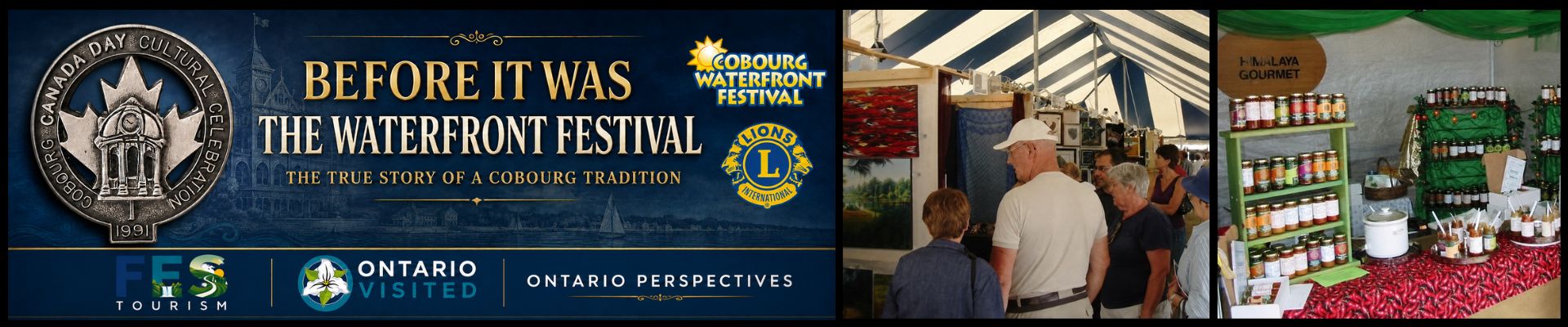
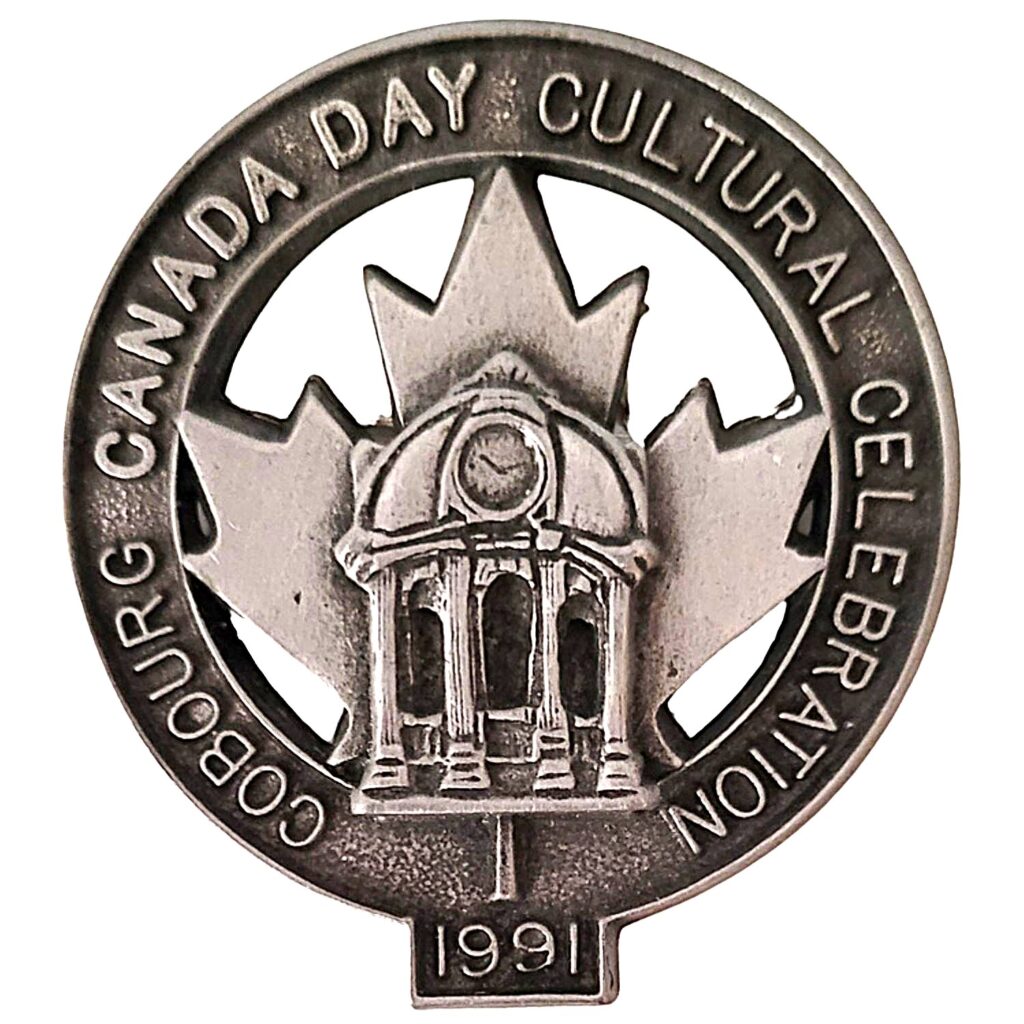
The 1991 commemorative medallion shown with this article is the only original festival artifact that remains in my possession. My handwritten planning notes and Edwin Matthews’ original watercolour sketch of Victoria Hall were later presented to then-Mayor Gil Brocanier for placement in the Cobourg archives. Although I cannot reproduce those materials here, their transfer to the Town forms an important part of this historical account.
A Story That Deserves to Be Told Correctly
Over the years, several accounts have been written about the origins of the Cobourg Waterfront Festival. Unfortunately, some have combined separate events, credited organizations that were not involved at the beginning, or connected the modern festival to an earlier arts and crafts show with which it had no organizational relationship.
I believe it is time to set the record straight—not to diminish anyone who contributed later, but to recognize the people and organizations that were actually there when the festival was created.
This is the story as I remember it, as one of the event’s co-founders and one of the overall Cobourg Waterfront Festival Chairs.
A Chance Meeting at the Royal Winter Fair
The story began in 1989 at the Royal Agricultural Winter Fair in Toronto, where Judi and I had an art booth. While we were there, I was approached by Henry Cole.
Henry asked whether I knew anything about art festivals. He told me he had a great idea: he wanted to create an art festival in Cobourg and hoped he could convince the local Lions Club to sponsor it.
As it happened, I did know something about art festivals.
I was working with Edwin Matthews, founder of the Buckhorn Wildlife Art Festival. Judi and I were also preparing for a two-month, cross-country promotional tour for a Canadian Park Partnership program produced by the Buckhorn Art Publishing Company, which Matthews owned. The program featured a series of art prints by Canadian artist Michael Dumas.
I explained all of this to Henry. I also told him that, after returning from our trip, Judi and I planned to leave Port Perry, although we had not yet decided where we would live.
Henry’s eyes lit up.
He suggested that we move to Cobourg and help him establish the festival.
I replied—partly in jest—that if he could find us both a place to live and a suitable building for the new art gallery we planned to open, we might consider it.
Before we left on our trip, Henry telephoned. He believed he had found two perfect properties.
Judi and I drove to Cobourg to see the community and inspect the properties. We loved what we found. We decided that, when our trip was over, Cobourg would become our new home.
Turning the Idea into a Plan
After we moved to Cobourg in 1990, the serious planning began.
Judi and I met with Henry and his wife, Debbie, at their home. Together, the four of us discussed what an art festival in Cobourg might look like. As the ideas flowed, I began writing notes—outlining how the event could operate, what it would require and what it might cost.
We also discussed how we could present the proposal to the Cobourg Lions Club. Before approaching the club, however, we spoke with Wayne Deveau, the Town of Cobourg employee responsible for community program development.
Wayne liked the concept and presented it to Mayor Angus Read, who also supported the idea.
With that municipal encouragement, we were ready to approach the Lions Club.
Henry, who was a Lions member, invited me to attend one of the club’s meetings as his guest. Club president Arnold McCurdy introduced us, and Henry and I presented the proposed art festival and explained how we believed it could work.
The Lions considered the proposal and voted to proceed. Their commitment went far beyond lending the club’s name to the idea. The Cobourg Lions Club agreed to contribute $20,000 and to become deeply involved in organizing and managing the new event.
I was subsequently invited to join the Lions Club. I accepted and became both a club member and a member of the festival organizing committee.
The First Celebration
The first event was held in 1991 under its original name: the Cobourg Canada Day Cultural Celebration.
Henry and Debbie Cole, along with Judi and me, were the co-founders of the event that would eventually become known as the Cobourg Waterfront Festival. The Cobourg Lions Club was the only service club involved in that inaugural year.
The first celebration brought together three elements:
- the new Lions Club art festival;
- the Town of Cobourg’s Canada Day activities; and
- an existing local arts and crafts show.
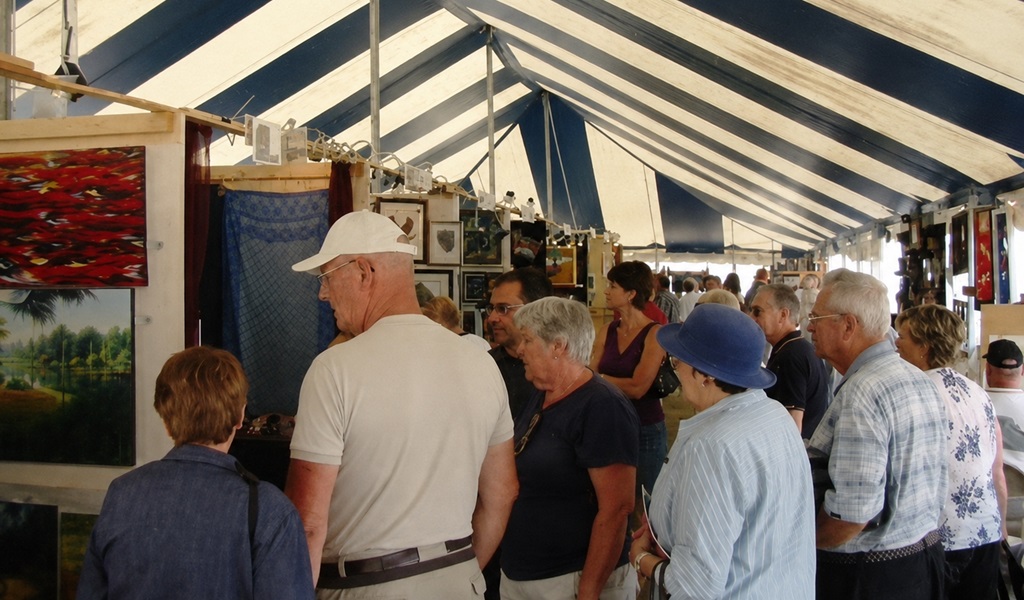
More than 70 artists participated. Many came from outside the community and were billeted in the homes of Lions Club members and their friends. That hospitality was one of many examples of how fully the Lions and Lionesses embraced the new event and helped make it possible.
A Painting to Mark the Beginning
To commemorate the creation of the festival, we commissioned Edwin Matthews to paint Cobourg’s historic Victoria Hall.
The image was reproduced as a series of signed, limited-edition prints. The framed prints, which included a Cobourg Canada Day Cultural Celebration pewter medallion, were offered for sale to Lions Club members and interested community residents. The commemorative medallions were also sold separately.
The original painting was presented to the Town of Cobourg and, to the best of my knowledge, was hung in Victoria Hall. Years later, I also presented then-Mayor Gil Brocanier with Edwin’s original watercolour sketch of Victoria Hall and my handwritten festival planning notes so they could be placed in Cobourg’s archives.
Those materials are more than memorabilia. They are part of the documentary history of how the festival actually began.
What About the 1967 Arts and Crafts Show?
An arts and crafts show had been established in Cobourg in 1967 as part of Canada’s Centennial celebrations. I believe it may have been organized by Cam Christie, a reporter with the Cobourg Daily Star.
By the time we were developing the new festival, that show had a relatively small number of participants and was no longer being held on Canada Day.
We invited Cam and his group to participate in the 1991 Cobourg Canada Day Cultural Celebration. Although they were reluctant, they agreed to try joining the event and operated in an area separate from the main Lions Club location.
The following year, the group decided not to return.
Their 1967 show was therefore not the beginning of the modern Cobourg Waterfront Festival. It was a separate, earlier event whose organizers were invited to participate in the newly created 1991 celebration.
That distinction matters.
When Rotary Became a Partner
After the arts and crafts group chose not to participate in the second year, we approached the Rotary Club of Cobourg. Rotary was asked whether it would take responsibility for organizing and operating the craft portion of the festival.
Rotary agreed and joined the event in 1992.
The club became an important festival partner and made an enormous contribution to its growth and success. However, Rotary was not one of the festival’s founders and was not involved in the inaugural 1991 celebration.
Recognizing Rotary’s later contribution does not require rewriting the festival’s beginning. Both parts of the story can—and should—be told accurately.
Building the Waterfront Festival
Following Rotary’s arrival, an overall Cobourg Waterfront Festival committee was established. Wayne Deveau served as its first chair.
After Wayne, I chaired the overall committee for four years. Trish Kulik succeeded me.
As the event evolved, many individuals, municipal employees, service-club members and community volunteers added their ideas, energy and leadership. What began as an art-festival concept grew into a major community celebration associated with Cobourg’s waterfront and Canada Day weekend.
That growth deserves to be celebrated. But so does the small group of people who took the first risks, developed the original plan, found the funding and transformed an idea into a real event.
Setting the Record Straight
The modern festival’s history did not begin in 1967. It began with Henry Cole’s idea in 1989, the planning work undertaken in 1990 and the first Cobourg Canada Day Cultural Celebration in 1991.
Henry and Debbie Cole, and Judi and Gary McWilliams, were its co-founders. The Town supported the concept, and the Cobourg Lions Club provided the sponsorship, financial commitment, volunteers and organizational strength needed to make the inaugural event possible.
The Rotary Club joined in 1992 and became a valued partner in the festival’s continuing development.
This history is not being told to take credit away from anyone. It is being told to give proper recognition to everyone—especially the remarkable Lions and Lionesses whose work, generosity and belief helped turn a new idea into an enduring Cobourg tradition.
The Founding Timeline
1989 — Henry Cole approached Gary McWilliams at the Royal Agricultural Winter Fair with his idea for a Cobourg art festival.
1990 — Gary and Judi McWilliams moved to Cobourg, bringing their art-event experience and industry connections with them.
1990 — Henry and Debbie Cole and Gary and Judi McWilliams developed the concept and approached the Town of Cobourg and the Cobourg Lions Club.
1990 — The Cobourg Lions Club agreed to sponsor and organize the event, committing $20,000 to the project.
1991 — The first Cobourg Canada Day Cultural Celebration was held. It included the Lions Club art festival, the Town’s Canada Day activities and the participating arts and crafts show. More than 70 artists took part.
1991 — Signed, limited-edition prints of Edwin Matthews’ Victoria Hall painting and commemorative pewter medallions were offered for sale. The original painting was presented to the Town of Cobourg.
1992 — After the earlier arts and crafts group withdrew, the Rotary Club of Cobourg joined the festival and took responsibility for its craft component.
After 1992 — An overall Cobourg Waterfront Festival committee was formed, with Wayne Deveau serving as its first chair. Gary McWilliams later chaired the committee for four years and was succeeded by Trish Kulik.
Ontario Perspectives
Ontario Perspectives is an Ontario Visited series exploring the people, decisions and experiences that have shaped Ontario’s festivals, attractions, communities and visitor experiences.