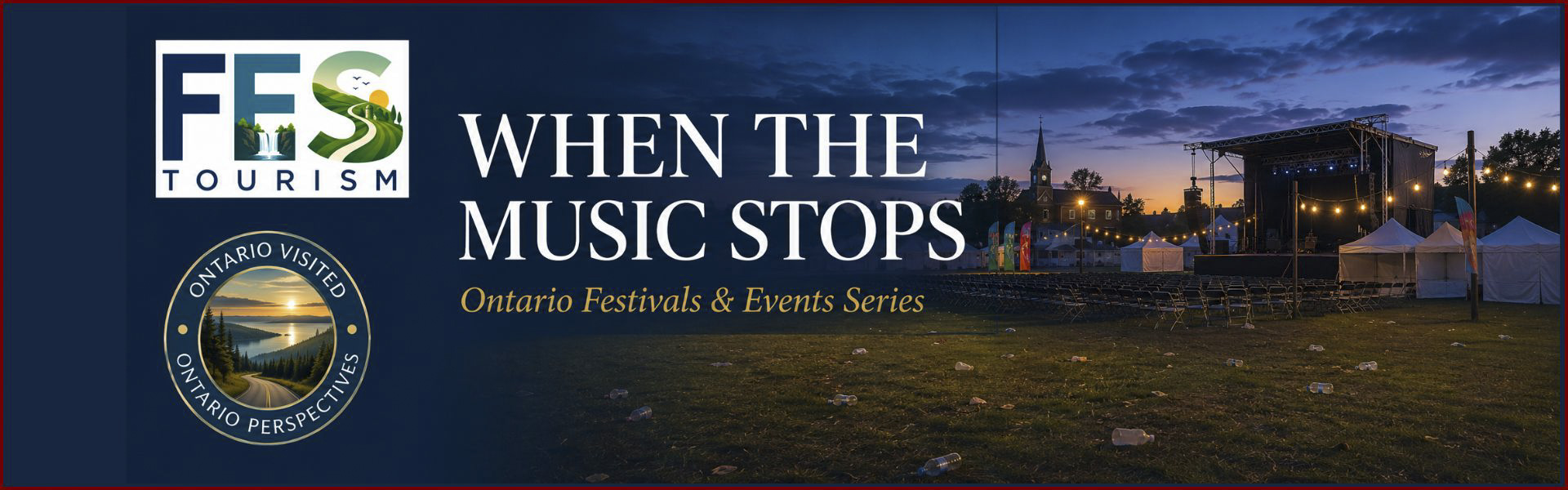













WHEN THE MUSIC STOPS
“The Fight to Save Ontario’s Festivals and Events”
PART EIGHT OF TEN
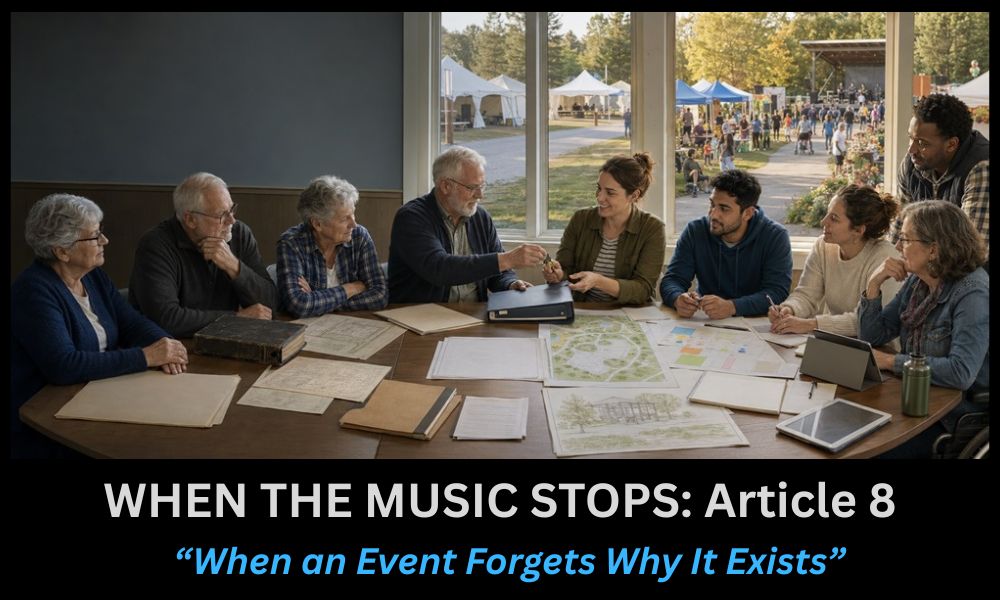
When an Event Forgets Why It Exists
“How Complacency, Aging Leadership and the Loss of Purpose Can Quietly Destroy a Successful Festival”
Ontario Perspectives • Special Investigative Series
Executive Summary
Not every festival disappears because its funding was withdrawn, its insurance became unaffordable or severe weather forced its cancellation.
Some events slowly weaken from within.
They continue presenting the same activities because those activities have always been presented. The same people retain the same responsibilities. New volunteers are welcomed as workers but not developed as leaders. Suggestions are treated as criticism, declining attendance is explained away and tradition gradually becomes an excuse for avoiding change.
The event may continue operating for years, but its connection to the community weakens. Volunteers become tired. Audiences change. Sponsors lose interest. Programs become less relevant and no one can clearly explain what the festival is trying to accomplish.
In my experience, most struggling events eventually reach a crisis through one or more of three primary causes:
- Financial instability.
- Aging leadership without a succession plan.
- Loss of direction or purpose.
These causes rarely operate separately. An event that has lost its purpose becomes harder to fund. An aging leadership group may resist the changes needed to reconnect with the community. Financial pressure can force organizers to concentrate on surviving the current year rather than preparing for the future.
Yet established festivals also possess advantages that new events must spend years developing: history, public awareness, community relationships, experienced volunteers, traditions, suppliers, sponsors and generations of memories.
Most struggling events do not need to be cancelled.
They need to understand what remains valuable, release what no longer serves the community and create a new path that combines experience with fresh leadership.
Renewal is not the abandonment of tradition.
It is how worthwhile traditions remain alive.
About This Series
When the Music Stops is a ten-part examination of the pressures threatening Ontario’s festivals, fairs and community events—and the actions that could help them survive.
These gatherings generate economic activity, preserve traditions, develop volunteers and future leaders, and give communities a shared sense of identity.
When a long-running event disappears, the community loses more than a date on its calendar.
A little of the community disappears with it.
Events Rarely Die on the Day They Are Cancelled
The final announcement may arrive suddenly.
A board posts a message saying the festival will not return. A municipal council learns that the organizing committee has dissolved. Vendors receive an email explaining that the event has been cancelled indefinitely.
To the public, it can appear that the festival died that day.
Usually, it did not.
The decline may have started years earlier.
It began when a respected chairperson tried to retire but no one was prepared to replace them. It continued when attendance declined and the committee blamed the weather without examining the program. It deepened when new volunteers suggested changes and were told they did not understand the event’s history.
A sponsor quietly withdrew. A key volunteer left. Another committee position went unfilled. A traditional attraction became more expensive while drawing fewer visitors.
Each decision appeared manageable on its own.
Together, they formed a pattern.
By the time the public learned that the festival was in trouble, the organization may have exhausted its money, its leadership and its belief in the future.
The cancellation was only the final stage of a much longer decline.
The Three Roads to Failure
Over many years of organizing, attending and observing community events, I have seen three causes appear repeatedly.
Financial instability
An event cannot continue indefinitely when expenses exceed dependable income.
The crisis may be caused by inadequate grants, declining sponsorship, poor budgeting, rising costs, weak financial controls or dependence upon one major revenue source. It can also result from programming ambitions that have grown beyond the organization’s capacity.
Financial difficulty is often visible, but its underlying cause may not be.
A festival may believe it has a funding problem when it actually has a relevance problem. Sponsors and visitors may be withdrawing because the event no longer provides enough value.
Aging leadership without succession
Long-serving leaders are often the reason an event survived.
They know the history, suppliers, municipal contacts, operating routines and countless details never written down. Their experience is invaluable.
The danger occurs when that knowledge is not transferred.
If one person controls the contacts, passwords, contracts, banking information and decision-making, the organization may be only one illness, retirement or disagreement away from crisis.
Succession planning is not a request for experienced leaders to leave. It is a responsibility to ensure that what they created can continue after they do.
Loss of direction or purpose
This is often the least obvious and most dangerous cause.
An event can have money in the bank, volunteers on its committee and an audience at the gate—and still be losing its purpose.
It happens when organizers know what they have always done but can no longer explain why they are doing it.
Once purpose disappears, tradition becomes routine, programming becomes repetition and success is measured mainly by whether the event happened again.
The festival continues, but it stops moving.
Tradition and Repetition Are Not the Same
Tradition gives an event meaning.
It connects generations, preserves community stories and creates experiences people look forward to repeating. A parade, competition, ceremony or performance may remain valuable precisely because it has endured.
Repetition is different.
Repetition continues an activity without asking whether it still advances the event’s purpose or serves its audience.
The distinction is not determined by age.
A century-old tradition can remain relevant and emotionally powerful. A five-year-old program can already be stale.
The question is not, “How long have we done this?”
The question is, “Why does this still matter?”
An established event should be able to explain:
- Why it exists.
- Whom it serves.
- What community need it addresses.
- What experience it promises.
- Which traditions define it.
- What would be lost if it disappeared.
- How the community has changed.
- How the event must respond without abandoning its identity.
If organizers cannot answer those questions consistently, the event may be drifting.
“We Have Always Done It This Way”
Few statements are more dangerous to an established event.
“We have always done it this way” may sound like respect for tradition. Often, it signals that evaluation has stopped.
The statement can close discussion before an idea is examined. It can tell younger volunteers that their contribution is wanted only if they accept existing decisions. It can turn the experience of longtime organizers into a barrier rather than a resource.
Past success proves that earlier decisions worked under earlier conditions.
It does not prove that the same decisions will work forever.
Communities change. Families change. Audiences discover entertainment differently. Volunteers have different expectations. Businesses reconsider sponsorship. Accessibility standards improve. Cultural awareness evolves. Costs rise and available sites change.
An event that refuses to respond is not preserving itself.
It is slowly separating itself from the community that once made it successful.
A View from the Festival Road
Two Leadership Models, Two Very Different Futures
Judi and I helped establish a major community festival in the late 1980s. As it developed, the event eventually involved three principal partners, including two community service organizations and a municipal celebration committee.
Each service organization managed an important section of the festival.
Both groups were committed. Both had capable volunteers. Both contributed substantially to the event’s success.
Their leadership systems, however, were very different.
One organization relied upon many of the same members year after year. That provided continuity and experience. Its leaders knew how the site worked, what had succeeded previously and how to complete the job.
The other organization used a rotating three-year leadership structure.
A member began as vice-chair, learning the operation and supporting the current chair. The following year, that person became chair. In the third year, they remained involved as past chair, helping the next leader.
At any given time, its committee leadership contained three perspectives:
- A newer leader preparing to assume responsibility.
- A current leader empowered to make decisions.
- An experienced former leader available to provide continuity and advice.
The system did more than replace chairpeople. It continually introduced new ideas while preserving organizational memory.
The difference became clear during a meeting about the following year’s festival.
Members of the rotating-leadership organization were eager to discuss new ideas and possible improvements. A senior representative of the other organization brought the discussion to an end with words I have never forgotten:
“We have been doing this for a long time, and it has worked out pretty well. I don’t see any reason for changes.”
The meeting ended, but the consequences of those two attitudes continued.
The organization with rotating leadership remained open to new ideas and developed new people capable of carrying them forward. Over time, it prospered and assumed a stronger leadership role within the festival.
The organization that had relied upon the same people and resisted change remained involved, but in a much smaller capacity.
The festival itself has survived for more than three decades. That is important. The story is not about one organization being good and the other being bad. Both contributed to building something valuable.
It is about what different leadership structures produce over time.
One system depended heavily upon the knowledge and preferences of established members.
The other intentionally combined experience with renewal.
The first protected the way the work had always been done.
The second protected the organization’s ability to continue doing the work in the future.
Continuity Without Renewal Becomes Stagnation
Experienced volunteers often fear that new leaders will discard everything that made the event special.
That fear is understandable.
New people may not know why certain decisions were made. They may underestimate the importance of a tradition, relationship or operational detail. Change introduced without listening can damage an event as easily as refusing to change.
The solution is not to choose between experience and new leadership.
The solution is to connect them.
Experienced organizers should explain the history, values, relationships and lessons behind the event. Emerging leaders should be encouraged to question assumptions, examine changing audiences and introduce carefully tested ideas.
Continuity protects the event from forgetting where it came from.
Renewal prevents it from becoming trapped there.
New Volunteers Need More Than Jobs
Many festivals say they need younger volunteers.
What they sometimes mean is that they need younger people to fill shifts, move equipment, sell tickets, clean tables or supervise activities designed by someone else.
Those tasks matter, but they do not create future leaders on their own.
A volunteer who is never invited into planning discussions does not learn how decisions are made. A young person whose suggestions are dismissed does not develop a sense of ownership. Someone given responsibility without authority soon realizes that the title is largely symbolic.
Leadership development requires a deliberate path:
- Invite the volunteer to observe and learn.
- Assign a defined responsibility.
- Provide an experienced mentor.
- Allow the volunteer to make real decisions.
- Review what worked and what did not.
- Increase responsibility gradually.
- Prepare the person to lead.
- Keep the former leader available as an adviser without allowing them to retain control.
Succession is not finding someone willing to inherit an impossible workload.
It is making leadership achievable before asking someone to accept it.
Founder’s Strength Can Become Founder Dependence
Many successful festivals began because one or two determined people refused to let an idea die.
Founders supply energy, identity, contacts and persistence. During the early years, the event may need their singular vision to survive.
Problems develop when the organization never grows beyond that stage.
If every decision must be approved by the founder, other leaders cannot mature. If relationships belong to the individual rather than the organization, they may leave when that individual leaves. If questioning the founder is treated as disloyalty, problems remain unspoken.
Imagine Canada warns that founder dependence can limit innovation, contribute to turnover and eventually threaten organizational survival. Strong governance, open communication and early succession planning can reduce those risks.
Honouring a founder does not mean preserving every decision permanently.
The greatest recognition may be building an organization capable of carrying the founder’s purpose into another generation.
Sources: Imagine Canada—Passing the Torch: Succession Planning in Founder-Led Nonprofits; Imagine Canada—Good Governance and Leadership in Founder-Led Organizations
The Signs That an Event Is Losing Its Way
Decline does not always appear in the financial statement first.
Warning signs may include:
- Committee meetings concentrate on logistics but rarely discuss purpose.
- The program remains almost identical every year.
- Suggestions are routinely answered with “We tried that once.”
- The same people occupy leadership positions indefinitely.
- No one is being prepared to replace key organizers.
- Attendance is declining or becoming less diverse.
- Younger residents do not see the event as relevant to them.
- Volunteers are recruited for work but excluded from decisions.
- Sponsors receive the same proposal regardless of their objectives.
- Community partners are treated as suppliers rather than collaborators.
- Complaints are dismissed instead of examined.
- Traditions are defended without explaining their value.
- Programs continue because one influential person likes them.
- The event cannot identify what distinguishes it from other celebrations.
- Success is measured only by attendance, revenue or the absence of disaster.
- Organizers spend more time protecting positions than developing the event.
- People speak proudly about the past but rarely enthusiastically about the future.
One sign alone does not prove an event is failing.
A pattern should trigger honest examination.
Renewal Begins with Purpose
A struggling event should not begin by asking, “What new attraction can we add?”
It should begin with a more fundamental question:
Why should this event continue?
That may sound harsh, but the answer can become the foundation of renewal.
The purpose should not be a vague statement such as “to provide fun for everyone.” It should describe the event’s specific relationship with its community.
For example:
- To celebrate a community’s cultural identity.
- To connect residents with local agriculture.
- To preserve and interpret local history.
- To animate a downtown and support its businesses.
- To create a welcoming gathering place for new and longtime residents.
- To provide artists with an audience and community.
- To mark an important season, anniversary or civic tradition.
- To raise funds while strengthening community participation.
Once the purpose is clear, every major program can be tested against it.
Does this activity advance the purpose?
Does it serve the intended audience?
Does it distinguish the event?
Is its value greater than its financial and volunteer cost?
Would the event lose part of its identity if the activity disappeared?
If the answer to those questions is no, the activity may be a habit rather than a tradition.
The Community Must Be Part of the Examination
An event cannot rediscover its community purpose by consulting only the people currently running it.
Organizers should listen to:
- Current attendees.
- Former attendees.
- Residents who have never attended.
- Volunteers who left.
- Local businesses.
- Sponsors and former sponsors.
- Municipal staff and elected representatives.
- Community organizations.
- Cultural and accessibility advocates.
- Young people and families.
- Vendors, performers and suppliers.
- Residents affected by traffic, noise or site use.
The objective is not to surrender every decision to public opinion.
It is to understand how the event is experienced beyond the committee room.
Sometimes the results will be uncomfortable. A beloved program may have lost its audience. A scheduling decision may exclude families. The event may be viewed as belonging to one group rather than the wider community.
Honest information is more useful than comforting assumptions.
Protect the Heart, Change the Rest
Renewal does not require discarding everything.
An established festival should identify three categories.
The heart
These are the traditions, values and experiences without which the event would no longer be itself. They should be protected, interpreted and passed forward.
The supports
These are programs and practices that still contribute but can be improved, modernized or delivered differently.
The habits
These are activities continued mainly because they have always been present, someone has personal ownership of them or removing them would create an uncomfortable conversation.
The heart should be preserved.
The supports should be strengthened.
The habits should be challenged.
This distinction allows an event to change without losing its identity.
Renewal Does Not Have to Happen All at Once
Large, sudden change can frighten volunteers, confuse audiences and place the event’s finances at risk.
A better approach is often to test carefully.
An event can:
- Pilot one new program.
- Refresh one underperforming area.
- Invite a new partner to lead a defined activity.
- Change the hours on one day.
- Create a youth-led component.
- Test a new layout or accessible route.
- Retire one program whose cost exceeds its value.
- Survey visitors before and after the change.
- Compare attendance, revenue and volunteer response.
- Keep what works and revise what does not.
Small experiments make change less threatening.
They also replace arguments based on personal preference with evidence.
Sometimes an Event Needs to Become Smaller
Growth is not the only sign of success.
A festival may have expanded beyond its financial, volunteer or community capacity. It may be presenting too many activities, occupying too much land or operating for more days than its audience can support.
Renewal may require reduction.
A smaller event with a clear identity, reliable finances and engaged volunteers is healthier than a large event held together by exhaustion and hope.
Reducing the program can protect the event’s strongest traditions, improve quality and give organizers the capacity to rebuild.
The goal is not to produce the largest possible festival.
It is to produce an event the community can sustain.
A Pause Is Not Necessarily a Death
Some events may need to pause for a year.
That decision should not be made casually. A missed year can weaken sponsorship, public habits and volunteer involvement. But proceeding with an event that is financially or organizationally unprepared can cause greater damage.
A planned pause should have:
- A defined reason.
- A renewal committee.
- A public explanation.
- A timetable.
- Continued communication with volunteers and sponsors.
- Protection of the organization’s name, records and assets.
- A realistic relaunch plan.
A pause without a plan often becomes permanent.
A pause used deliberately can create the space required for renewal.
Research into festival life cycles recognizes that events may follow several paths, including continued growth, consolidation, decline, reinvention and cancellation. Decline is not always inevitable, but renewal requires organizers to recognize the stage the event has reached.
Source: The Event and Festival Life Cycle—Developing a New Model for a New Context
Keeping the Celebration Alive
What Event Boards Can Do
- Conduct an annual purpose review
Ask whether the event is still fulfilling its mission and serving its community. Do this before a crisis forces the discussion.
- Place succession permanently on the agenda
Succession should be treated as risk management, not as a conversation delayed until someone announces retirement.
- Introduce rotating leadership
Vice-chair, chair and past-chair structures can combine preparation, authority and continuity.
- Use reasonable term limits
Term limits should not force valuable people out of the organization. They should move experienced people into mentoring and advisory roles while creating room for new leaders.
- Document essential knowledge
Maintain current files containing contacts, contracts, passwords, site plans, timelines, permits, budgets, grant requirements and post-event reports.
- Evaluate every major program
Record attendance, cost, revenue, volunteer requirements, participant response and connection to the event’s purpose.
- Invite constructive disagreement
A healthy board can question an established practice without questioning the commitment of the person who created it.
- Create an emergency leadership plan
The event should know who can assume responsibility if a chairperson, treasurer or key organizer becomes suddenly unavailable.
Succession planning is a continuing governance responsibility, not a one-time document.
Sources: Imagine Canada—You Need a Succession Plan; Imagine Canada Standards
What Municipalities and Funders Can Do
Municipalities and funders should not wait until a festival is close to collapse before asking about sustainability.
Applications and partnership discussions can encourage events to demonstrate:
- Leadership succession.
- Financial reserves.
- Volunteer development.
- Community consultation.
- Program evaluation.
- Accessibility.
- Strategic direction.
- Knowledge transfer.
Support should also be available for renewal work—not only for public programming.
A grant that pays for another performer may produce one successful afternoon. Support for governance, community research, strategic planning or volunteer development may protect the entire event.
Funders should recognize that renewal costs money even when the work is invisible to visitors.
What Experienced Leaders Can Do
Longtime organizers possess knowledge their communities cannot easily replace.
Their responsibility is not simply to continue working until they can work no longer.
It is to:
- Identify potential successors.
- Explain the reasons behind important decisions.
- Share relationships and contacts.
- Allow emerging leaders to make decisions.
- Accept that a successor may lead differently.
- Remain available without taking control back.
- Celebrate the continuation of the event as part of their legacy.
A leader’s greatest success is not becoming indispensable.
It is creating an organization capable of continuing without them.
What Emerging Leaders Can Do
New leaders also have responsibilities.
They should:
- Listen before changing.
- Learn the event’s history.
- Respect the people who built it.
- Ask why established practices exist.
- Separate outdated methods from valuable traditions.
- Bring evidence as well as enthusiasm.
- Accept responsibility, not merely offer opinions.
- Understand that renewal takes patience and trust.
The event needs their ideas.
It also needs their commitment.
Reasons for Hope
Established festivals have something new events do not: a foundation.
They may possess community awareness, recognized traditions, experienced volunteers, municipal relationships, supplier contacts, sponsorship history, equipment and public goodwill.
Even when attendance has declined or leadership has weakened, those assets may still exist.
Renewal does not begin from nothing.
It begins by identifying what remains strong.
An honest review may reveal that the event’s central purpose is still deeply valued. The problem may be an outdated program, inaccessible site, exhausted committee or leadership structure that no longer allows new people to advance.
Those problems can be addressed.
A rotating leadership system can be introduced. Programs can be evaluated. New community partners can be invited. The event can become smaller, clearer and more financially realistic.
Most importantly, experienced organizers and emerging leaders can work together.
The past does not have to defeat the future.
It can prepare it.
The Courage to Change
It takes courage to create a new event.
It takes a different kind of courage to admit that an established event must change.
Founders and longtime volunteers may feel that questioning the program questions the value of their work. It does not.
Their work created something worth saving.
Renewal honours that contribution by ensuring that the event remains meaningful to the people who will inherit it.
The most dangerous moment in a festival’s life may not be when someone proposes a difficult change.
It may be when no one is willing to propose one.
The Purpose Beneath the Program
A festival is not its stage, parade, midway, vendors or fireworks.
Those are ways of expressing something deeper.
The event may exist to celebrate identity, preserve history, connect neighbours, support local businesses or give a community a reason to gather.
Programs can change while that purpose remains.
Sometimes they must change so the purpose can survive.
Most struggling events do not need to be cancelled. They need an honest diagnosis, a renewed sense of direction and a leadership structure capable of carrying the event forward.
When an event remembers why it exists, decisions become clearer.
Traditions regain meaning. New ideas have a standard against which they can be judged. Volunteers understand what they are building and sponsors understand why it matters.
The festival stops surviving from year to year.
It begins moving toward a future.
Coming in Part Nine
A New Model for Survival
Ontario’s festivals cannot solve modern challenges using only yesterday’s organizational structures.
Part Nine will bring the lessons of this series together into a practical new model based on diversified funding, shared services, professional support, succession planning, community partnerships, realistic programming and year-round organizational strength.
It will examine how festivals can move from annual crisis management toward long-term resilience.
Explore the Series
- Part One: The Celebration We Could Lose
- Part Two: The Funding Crisis Behind the Fireworks
- Part Three: When Red Tape Replaces the Welcome Mat
- Part Four: The Cost of Being Careful
- Part Five: Who Will Raise the Tent Tomorrow?
- Part Six: When Nature Changes the Plan
- Part Seven: Who Will Speak for Ontario’s Festivals Now?
- Part Eight: When an Event Forgets Why It Exists
- Part Nine: A New Model for Survival
- Part Ten: Ontario’s Call to Action
Special Report
What Happened to Festivals and Events Ontario?
The Sudden Closure, the Unanswered Questions and the Search for Ontario’s New Festival Voice
Links can be added as the articles are published on Ontario Perspectives and OAT Field Notes.
Selected Sources and Further Reading
- Imagine Canada—Passing the Torch: Succession Planning in Founder-Led Nonprofits
- Imagine Canada—Good Governance and Leadership in Founder-Led Organizations
- Imagine Canada—You Need a Succession Plan
- Imagine Canada Standards—Governance, Accountability and Volunteer Involvement
- The Event and Festival Life Cycle—Developing a New Model for a New Context
- Capacity Canada—Nonprofit Governance and Leadership Resources
The anonymous case study in this article is based upon Gary McWilliams’ firsthand experience with a long-running Ontario community festival. Identifying names and locations have intentionally been omitted because the purpose is to examine the leadership lesson, not criticize the participating organizations.