












WHEN THE MUSIC STOPS
“The Fight to Save Ontario’s Festivals and Events”
PART FOUR OF TEN
THE WEIGHT OF RESPONSIBILITY
“Insurance, Regulations and the Growing Burden Carried by Ontario Event Organizers”
Ontario Perspectives • Special Investigative Series
EXECUTIVE SUMMARY
Every Ontario festival and event has a responsibility to protect its visitors, volunteers, workers, vendors and surrounding community. Insurance, food-safety requirements, alcohol regulations, accessibility standards, building inspections, traffic plans, emergency procedures and security measures exist for important reasons.
The problem is not the existence of these protections. It is the complicated and sometimes inconsistent system through which volunteer organizers must understand, coordinate, finance and document them.
Depending on its location and programming, an event may need to work with municipal departments, police, fire services, paramedics, public-health authorities, building officials, road departments, the Alcohol and Gaming Commission of Ontario, the Technical Standards and Safety Authority, electrical inspectors, insurers, property owners and copyright-licensing organizations.
A single programming decision—adding a beer garden, food trucks, inflatables, animals, a stage or road closure—can introduce several new permits, insurance conditions, inspections and staffing requirements.
Municipalities commonly require millions of dollars in liability coverage and may need to be named as additional insured parties. Vendors and contractors may also have to supply their own certificates. However, basic liability insurance may not protect an event against the financial loss caused by cancellation, extreme weather, wildfire smoke or poor attendance.
Ontario does not need weaker safety, accessibility or insurance standards. It needs earlier guidance, better coordination, greater consistency, affordable risk-management support and one clearly identified municipal contact who can help organizers understand the complete process.
ABOUT THIS SERIES
When the Music Stops is a ten-part FES Tourism special series examining the pressures confronting Ontario’s festivals and events. From funding, insurance and regulations to volunteers, weather, land use and the loss of Festivals and Events Ontario, the series explores what is at risk—and what must be done to protect the celebrations that help define Ontario.
THE BINDER BEHIND THE FESTIVAL
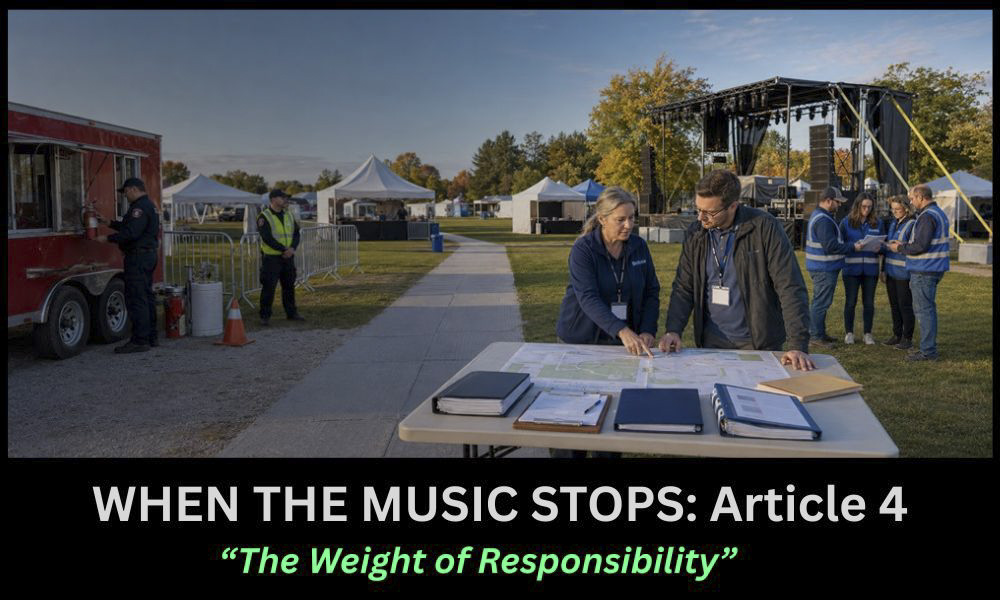
On the table beside the event chair sits a large binder.
It contains the site plan, insurance certificate, emergency contacts, road-closure approval, vendor agreements, liquor permit, security plan, food-service documents, volunteer schedule and copies of correspondence with municipal departments.
The public will never see it.
Visitors will notice the music, food, exhibits and entertainment. They will not know that the precise location of every tent, stage, propane appliance, washroom and barricade may have required review. They will not see the email confirming that the municipality was added to the insurance policy or the documents collected from every food vendor and equipment operator.
Yet without that binder—and the work it represents—the event may not be permitted to open.
Today’s organizer is not simply arranging a celebration. The organizer is accepting responsibility for a temporary public environment containing crowds, food, electricity, vehicles, structures, weather exposure and sometimes alcohol, animals, amusement rides or fireworks.
That responsibility is real.
It can also become overwhelming.
ONE EVENT—MANY AUTHORITIES
There is no single Ontario event authority responsible for every approval.
Depending on the event, an organizer may need to coordinate with:
- Municipal event staff
- Parks and recreation
- Roads and transportation
- Police
- Fire services
- Paramedics
- Public health
- Building officials
- By-law enforcement
- Licensing staff
- Conservation authorities
- Property owners
- The Alcohol and Gaming Commission of Ontario
- The Technical Standards and Safety Authority
- The Electrical Safety Authority
- Insurers
- SOCAN and Re:Sound
- Private security companies
- Accessibility specialists
Each organization sees an important part of the event. The festival committee must understand how all those parts fit together.
A park booking does not necessarily constitute event approval. A liquor permit does not replace municipal permission. A vendor’s insurance does not replace the organizer’s policy. A building permit for a stage does not approve its electrical installation. A road closure may require separate traffic, police and resident-notification arrangements.
The organizer becomes the person responsible for connecting systems that may not always communicate efficiently with one another.
THE REGULATORY DOMINO EFFECT
A seemingly simple programming decision can produce a chain of obligations.
Consider adding alcohol service.
The event may need:
- A Special Occasion Permit
- Municipal approval or a declaration of significance
- A defined and controlled service area
- Fencing or physical barriers
- Smart Serve-trained personnel
- Security
- An alcohol-management plan
- Age-verification procedures
- Additional washrooms
- Host liquor liability coverage
- Transportation planning
- Last-call and service procedures
- Municipal alcohol-policy compliance
The Alcohol and Gaming Commission of Ontario states that a Special Occasion Permit is required when alcohol is sold or served outside a licensed establishment or private place. Public events must follow the appropriate application and permit process.
Adding a food truck may require:
- Public-health approval
- Food-premises documentation
- Fire inspection
- Propane or fuel-system compliance
- Proof of insurance
- Vendor licensing
- Waste and wastewater arrangements
- Handwashing facilities
Adding a stage may introduce:
- Building permits
- Engineered drawings
- Fire and emergency access
- Electrical inspections
- Wind-management procedures
- Guardrails and accessible access
- Crowd-control requirements
Adding an inflatable or amusement device may require:
- TSSA documentation
- Qualified operators
- Vendor insurance
- Safe anchoring
- Electrical approvals
- Weather restrictions
- Additional supervision
The decision is rarely as simple as, “Would this be fun for visitors?”
It must also be:
“Can we legally, safely, financially and responsibly include it?”
INSURANCE: PERMISSION TO PROCEED
Insurance is one of the first questions organizers should investigate—not one of the final documents collected before opening day.
Many Ontario municipalities require event organizers to provide substantial general liability coverage and name the municipality as an additional insured party.
The Town of Niagara-on-the-Lake’s 2026 Special Event Policy, for example, requires permit holders to maintain at least $5 million in public liability insurance with the Town named as an additional insured.
West Grey’s event guidance also identifies $5 million in liability insurance for events using municipal facilities and adds further requirements when alcohol is involved.
Kincardine’s event application package illustrates how insurance requirements can extend through the event. The organizer may need $5 million in coverage, while participating food vendors may need their own liability insurance, health documentation, TSSA certification and fire approval.
These requirements protect the public, municipality and property owner. They also place significant responsibility on the organizer to confirm that everyone operating within the event is properly covered.
WHAT LIABILITY INSURANCE DOES—AND DOES NOT—PROTECT
General liability insurance generally addresses claims involving bodily injury or property damage associated with the insured event, subject to the policy’s terms, conditions and exclusions.
But festivals may need several other forms of protection:
- Directors’ and officers’ insurance
- Volunteer accident coverage
- Host liquor liability
- Property and equipment coverage
- Commercial automobile coverage
- Cybersecurity protection
- Crime or fraud coverage
- Event-cancellation insurance
- Non-appearance coverage
- Weather-related protection
An event can comply with a municipality’s liability requirement and still be financially exposed to cancellation.
If smoke, extreme heat, flooding, lightning or wind forces an event to close, liability coverage may protect against certain claims but not replace lost admissions, beverage sales, vendor revenue or unrecoverable production expenses.
Cancellation insurance may provide protection for specified circumstances, but coverage can be expensive, contain exclusions or be unavailable for particular risks. Organizers must understand exactly what is covered rather than assuming the word “insurance” means every loss is protected.
The most dangerous policy is one the committee has purchased but never properly understood.
THE ADDITIONAL-INSURED CHAIN
Insurance obligations can flow through the entire event.
The property owner requires coverage from the organizer. The organizer then requires coverage from contractors, food vendors, entertainers, midway operators and suppliers. Each may need to provide a certificate showing the required parties as additional insureds.
That creates a substantial administrative task:
- Establishing minimum coverage
- Providing exact insurance wording
- Collecting certificates
- Confirming expiry dates
- Identifying missing documentation
- Following up with participants
- Understanding which activities require additional protection
- Keeping documents available for inspection
A vendor may believe an ordinary business policy is sufficient, only to discover that off-site events, product liability, animals, alcohol or certain activities are excluded.
The event organizer is not an insurance broker, yet is often expected to identify whether the documentation appears adequate.
This is one area where qualified professional advice is essential.
THE PERSONAL WEIGHT ON VOLUNTEER DIRECTORS
Many festivals are operated by incorporated nonprofit organizations, agricultural societies, service clubs or informal community committees.
Board members may accept responsibilities involving:
- Contracts
- Employment
- Taxes
- Insurance
- Public money
- Health and safety
- Privacy
- Alcohol
- Financial reporting
- Accessibility
- Volunteer supervision
Some volunteers do not fully appreciate the extent of these obligations when they join a committee. Others understand the responsibility and decide they are unwilling to assume it.
This contributes to the leadership shortage examined later in this series.
It is easier to recruit someone to work at an information booth for four hours than to recruit a treasurer, chair or operations director who may feel personally responsible for decisions affecting thousands of visitors.
Good governance, clear policies, appropriate incorporation and directors’ and officers’ insurance can help. But the increasing weight placed on volunteer leaders cannot be ignored.
SAFE FOOD REQUIRES COORDINATION
Food is central to many festivals, fairs and cultural celebrations. It also introduces important public-health and fire-safety responsibilities.
Organizers may need to:
- Notify the local public-health unit
- Collect vendor applications
- Confirm food-source and preparation information
- Provide potable water
- Arrange handwashing
- Manage wastewater
- Ensure appropriate temperature control
- Provide waste disposal
- Confirm fire extinguishers and suppression equipment
- Verify propane and mobile-equipment compliance
- Allow inspections
- Remove vendors who do not comply
The organizer may not prepare a single meal, yet still carries responsibility for ensuring that vendors understand and satisfy participation requirements.
Deadlines matter. A food vendor accepted shortly before the event may not leave enough time for approvals. A vendor arriving without the required documentation can create conflict at the gate—especially after travelling, purchasing supplies and paying a participation fee.
Clear requirements must be provided before the vendor commits, not discovered during setup.
TEMPORARY STRUCTURES ARE STILL STRUCTURES
A tent, stage, platform or bleacher may exist for only a weekend, but temporary does not mean risk-free.
Wind, uneven ground, electrical cables, crowd movement and loading capacity all create hazards.
Depending on size and design, organizers may require:
- Building permits
- Engineered drawings
- Professional installation
- Flame-resistance documentation
- Anchoring or ballast
- Guardrails
- Fire extinguishers
- Emergency exits
- Accessible ramps
- Inspections
- Wind monitoring
- Evacuation or shutdown thresholds
West Grey’s event guide notes that some stages and temporary structures may be regulated by the Ontario Building Code and require permits based on their dimensions. Municipalities may also impose their own documentation and inspection procedures.
A volunteer committee cannot safely improvise technical compliance. It must engage qualified suppliers and understand who is responsible for inspection, weather monitoring and shutdown decisions.
ACCESSIBILITY IS BOTH A STANDARD AND A PROMISE
Accessibility requirements are sometimes included in discussions about regulatory burden. They must be approached differently.
Making events accessible is not merely an exercise in compliance. It is a promise that residents and visitors with disabilities, seniors, families and people with mobility challenges are welcome.
Ontario provides guidance to help businesses and nonprofit organizations understand accessibility responsibilities and make services, spaces and events more inclusive.
Accessible event planning can include:
- Parking and drop-off
- Firm, stable travel routes
- Entrance widths
- Accessible washrooms
- Seating and rest areas
- Clear signage
- Communication supports
- Website accessibility
- Service-animal access
- Support-person policies
- Viewing areas
- Sensory considerations
- Volunteer training
Many accessibility improvements are inexpensive when considered early. They become difficult and costly when added after the site has been designed.
The solution is not to lower expectations. It is to provide organizers with better tools, suitable infrastructure, funding and consultation.
Ontario’s aging population makes this even more important. Shade, hydration, rest areas, clear signs and walkable routes improve an event for almost everyone.
THE EMERGENCY PLAN NOBODY WANTS TO USE
An event may operate successfully for years without a major emergency. That does not eliminate the responsibility to prepare.
Plans may be needed for:
- Severe weather
- Lightning
- High winds
- Extreme heat
- Poor air quality
- Fire
- Medical emergencies
- Missing children
- Crowd movement
- Power failure
- Structural problems
- Vehicle incursions
- Threats or violence
- Evacuation
- Shelter-in-place
- Communications failure
The plan must identify:
- Who has authority to act
- How warnings are received
- How staff and volunteers are notified
- How visitors are informed
- Where people should go
- How emergency vehicles gain access
- When programming stops
- Who documents decisions
- How reopening or cancellation is determined
A written plan sitting in a binder is not enough. Key people must understand it. Volunteers need appropriate instructions. Contact information must be current. Decisions must not depend entirely on one person being available.
THE MUNICIPAL BORDER PROBLEM
One of the most frustrating difficulties is inconsistency.
Ontario’s municipalities differ in:
- Application forms
- Deadlines
- Insurance limits
- Site-plan expectations
- Road-closure procedures
- Alcohol policies
- Security requirements
- Fees
- Departmental responsibilities
- Definitions of event risk
- Available municipal assistance
Local differences are sometimes necessary. A major downtown street festival and a small rural gathering do not present identical conditions.
But unnecessary variation increases confusion. An organizer or supplier working successfully in one municipality may encounter completely different forms, timelines or insurance wording in the next.
A stronger provincial or sector-wide framework could standardize common terminology, templates and expectations while allowing municipalities to add requirements based on local circumstances.
A VIEW FROM THE FESTIVAL ROAD
Most event organizers do not object to keeping people safe.
They want clean food service, secure stages, responsible alcohol management, accessible grounds and sound emergency plans. Their names and reputations are attached to the event. The visitors are often their neighbours, friends and families.
The frustration begins when requirements arrive late, different departments provide conflicting information or volunteers discover an unexpected expense after contracts have been signed.
A committee can solve a problem it understands.
It cannot budget properly for a requirement it discovers two weeks before opening.
The best regulatory relationship is not one in which the municipality simply approves or rejects an application. It is one in which organizers and officials identify risks early and work together to resolve them.
REASONS FOR HOPE
Ontario already has many useful municipal guides, provincial resources and knowledgeable event professionals.
Several improvements are within reach:
- Municipal event coordinators
- One-window application systems
- Standard insurance language
- Shared emergency-plan templates
- Early risk-assessment meetings
- Online document portals
- Common vendor forms
- Regional training
- Insurance education
- Accessibility checklists
- Supplier accreditation
- Multi-year approval pathways for established events
- Pre-approved municipal event sites
Experienced organizers also possess valuable knowledge that can be shared. A provincial festival and event network could collect model documents and prevent hundreds of committees from independently recreating the same forms and procedures.
Technology can simplify document collection, reminders and approvals, although it must remain usable for small organizations without sophisticated systems.
KEEPING THE CELEBRATION ALIVE
PROVINCIAL ACTION
Ontario could support:
- A common special-event planning framework
- Standard terminology and model forms
- Insurance and risk-management education
- Accessibility resources
- Emergency-planning templates
- A shared online resource centre
- Training for volunteer directors
- Group insurance investigation
- Clearer coordination among provincial regulators
- Regular consultation with event organizers
MUNICIPAL ACTION
Municipalities can provide:
- One knowledgeable event contact
- A complete list of requirements at the beginning
- Coordinated departmental review
- Early site meetings
- Predictable fees
- Written explanations of changing requirements
- Reasonable timelines
- Multi-year processes for proven events
- Common vendor and contractor forms
- Accessible municipal event infrastructure
- A collaborative rather than strictly transactional relationship
INSURANCE-INDUSTRY ACTION
Insurers and brokers can help through:
- Plain-language explanations
- Event-specific risk reviews
- Clear statements of exclusions
- Group purchasing options
- Volunteer and director education
- Advice before programming is finalized
- Affordable products for small nonprofit events
- Better explanation of cancellation coverage
EVENT ORGANIZATION ACTION
Organizers should:
- Begin insurance and permit discussions early
- Identify every authority with jurisdiction
- Assign one person to manage compliance
- Create a master approval calendar
- Require vendor documents before setup
- Keep accurate records
- Use qualified contractors
- Read policies and exclusions
- Document incidents and decisions
- Train volunteers
- Conduct site inspections
- Review accessibility from the visitor’s perspective
- Reassess risk whenever programming changes
- Include compliance expenses in the first budget
- Never assume last year’s requirements remain unchanged
PROTECTION WITHOUT PARALYSIS
There is no responsible future for festivals without safety, accessibility, insurance and accountability.
There is also no sustainable future if volunteer organizers are buried under disconnected requirements they cannot understand, coordinate or afford.
Those truths do not have to conflict.
Strong standards and strong events can exist together when:
- Expectations are clear
- Advice arrives early
- Departments communicate
- Costs are predictable
- Organizers receive practical support
- Requirements reflect actual risk
- Accessibility is designed into the event
- Professional expertise is available
- Volunteers are not expected to become lawyers, engineers, insurers and emergency managers overnight
The objective should be protection without paralysis.
THE RESPONSIBILITY BEHIND THE CELEBRATION
When visitors enter an Ontario festival, they trust that the stage is secure, the food is safe, emergency routes are open and the people serving alcohol understand their responsibilities.
They rarely think about who created that assurance.
Usually, it was a combination of public officials, inspectors, suppliers, professionals and volunteers working for months before opening day.
That system protects people—and it should.
But the weight cannot continue increasing without stronger support for the people carrying it.
If Ontario wants professional, safe and accessible festivals, it must help community organizers meet professional expectations. Otherwise, the greatest risk may not be one poorly managed event.
It may be that responsible volunteers decide the burden has become too great to continue.
COMING IN PART FIVE
Permits, insurance and safety requirements can be managed when an organization has enough capable people. But across Ontario, the number of volunteers willing to accept year-round leadership and responsibility is shrinking.
In Part Five, When the Volunteers Go Home, we examine burnout, aging committees, missing successors and why an event can have hundreds of event-day helpers yet still be only one retirement away from disappearing.
EXPLORE THE SERIES
Previous Article: Part Three — The Rising Price of Opening the Gates
Series Home: When the Music Stops — Coming Soon
Next Article: Part Five — When the Volunteers Go Home — Coming Soon
Published by FES Tourism, operating as Ontario Visited and Ontario Agritourism.
SOURCES
Alcohol and Gaming Commission of Ontario — Special Occasion Permit Guide
Government of Ontario — Accessibility guidance for businesses and nonprofit organizations
Municipality of Kincardine — Special Event Application Package
Municipality of West Grey — Special Event Planning Guide
Town of Niagara-on-the-Lake — 2026 Special Event Policy