












WHEN THE MUSIC STOPS
“The Fight to Save Ontario’s Festivals and Events”
PART SIX OF TEN
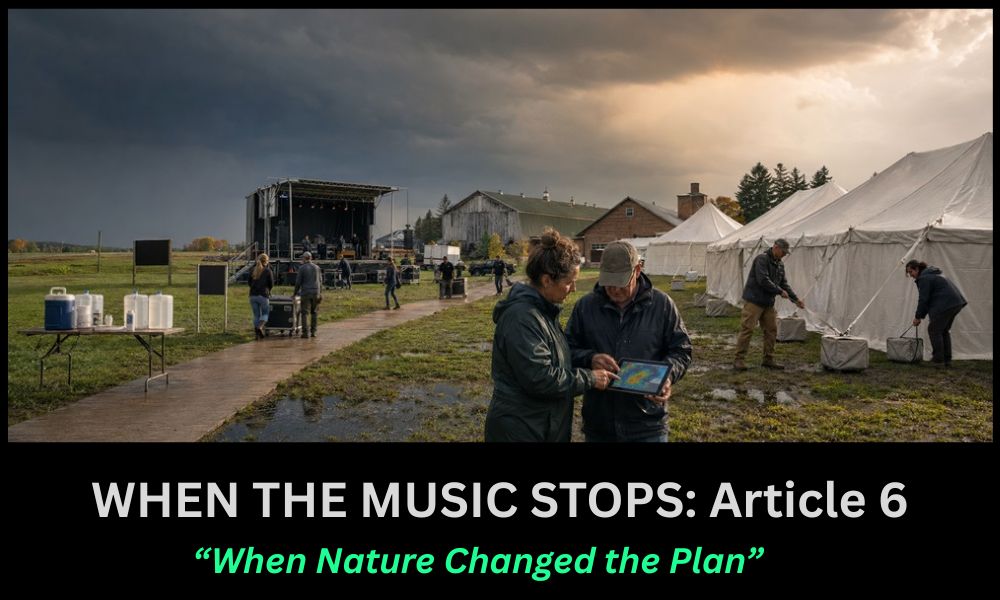
When Nature Changes the Plan
“Weather, Land and the Growing Vulnerability of Ontario’s Outdoor Events”
Ontario Perspectives • Special Investigative Series
Executive Summary
Outdoor festivals have always lived with uncertain weather. Rain dates, muddy fields and hurriedly secured tents are hardly new. What has changed is the range, severity and frequency of the conditions organizers must now prepare for.
Extreme heat can threaten visitors, volunteers, performers and animals. Wildfire smoke can make outdoor activity unsafe even when the fire is hundreds of kilometres away. Intense rainfall can flood grounds and parking areas. Strong winds can turn tents, signs and temporary structures into hazards. A storm forecast—or even the possibility of one—can affect attendance and revenue before the first drop of rain falls.
At the same time, many festivals are becoming less secure in the places they call home. Municipal parks, downtown streets, agricultural fairgrounds and privately owned fields face competing demands. Development, construction, environmental restrictions, recreation schedules, neighbourhood concerns, rising rental costs and changing municipal priorities can all threaten an event’s access to land.
These pressures are particularly dangerous because they affect the foundation on which an event is built. A festival can improve its programming, recruit volunteers and launch an excellent marketing campaign, but it cannot control the weather. Nor can it easily survive the loss of a site that has shaped its identity for decades.
The outlook is not entirely negative. Better forecasting, clearer emergency plans, climate-conscious site design, stronger municipal partnerships and long-term land-use agreements can make events more resilient. Adaptation is possible—but it requires planning, investment and a recognition that festival grounds are essential community infrastructure.
About This Series
When the Music Stops is a ten-part examination of the pressures threatening Ontario’s festivals, fairs and community events—and the steps that could help them survive.
These gatherings are more than entertainment. They generate economic activity, preserve traditions, support artists and small businesses, develop community leaders and give residents a reason to feel connected to the places they call home.
When a successful event disappears, the loss reaches far beyond the organizing committee. A little of the community disappears with it.
The Weather Has Always Been Part of the Story
Every experienced outdoor-event organizer knows the ritual.
In the days before an event, the weather forecast becomes required reading. Organizers study radar maps, debate the meaning of percentage probabilities and watch the sky with a level of concentration normally reserved for air-traffic controllers.
Will the rain arrive before the parade?
Will the field be dry enough for parking?
Can the entertainment continue if lightning is detected nearby?
Will the wind exceed the safe operating limits of the tents or stage?
For generations, organizers accepted that weather was part of the risk. Some years were hot. Some were cold. Some were wet. Most festivals developed their own collection of weather stories—storms survived, performances moved indoors and volunteers who kept smiling while standing ankle-deep in mud.
But the modern challenge is no longer simply whether it will rain.
Organizers must now consider extreme heat, poor air quality, wildfire smoke, flash flooding, severe thunderstorms, high winds and rapidly changing conditions. More importantly, several of these hazards can occur during the same event season.
The traditional rain plan is no longer enough.
A Summer of Warnings
Ontario’s 2026 summer festival season offered a sobering illustration of this expanding risk.
Wildfire smoke contributed to the cancellation or disruption of outdoor events in several communities. The first two nights of London’s Rock the Park were cancelled. Toronto cancelled FIFA Fan Festival activities and public watch parties at Nathan Phillips Square because of air-quality concerns. Hamilton Fringe cancelled programming, and Niagara Parks temporarily paused its nightly fireworks.
Other events faced extreme heat, torrential rainfall and flooding. East London’s Canada Day celebration was cancelled amid dangerous heat, while severe weather disrupted Canada Day activities in Ottawa.
These were not all the same kind of event, and no single weather incident should automatically be attributed to climate change. Together, however, they demonstrate the widening range of conditions that outdoor organizers must be prepared to manage.
The disruption does not end at the event gate. When a festival day is cancelled, food vendors lose sales, performers lose audiences, sponsors lose exposure and community groups lose fundraising opportunities. One cancelled day at London’s Colombian Gastronomy Festival reportedly affected more than 40 food vendors.
For a large public institution, cancellation may be financially painful but manageable. For an independent festival, a single lost weekend can erase a year’s work or endanger the following year’s event.
Weather has become not only an operational concern, but an existential one.
The New Weather Risk Is Complicated
The difficulty is not merely that conditions may be more severe. Different hazards require different responses.
Extreme heat
Heat creates risks for everyone, but it can be especially dangerous for children, older adults, people with existing health conditions, outdoor workers and volunteers completing long shifts.
Organizers may need cooling stations, shade, drinking-water access, adjusted schedules and medical-response capacity. Performances, parades and competitions may have to be moved to cooler hours.
At agricultural fairs and rural events, heat planning must also include livestock. Animals in barns, show rings, trailers and temporary enclosures require ventilation, water and carefully monitored conditions. The decision to continue an activity cannot be based solely on human comfort.
Wildfire smoke and poor air quality
Smoke is particularly difficult because an event may have blue skies overhead while the air remains unhealthy. Conditions can change quickly and may affect people differently.
Moving visitors into a tent does not solve an air-quality problem. In some circumstances, it may make heat exposure worse.
Event organizers need to understand the Air Quality Health Index, establish decision thresholds in advance and determine who has the authority to postpone or cancel activities. They also need a way to explain those decisions to visitors who may not immediately see the danger.
Intense rainfall and flooding
Rain can do more than inconvenience an audience. It can make parking fields unusable, create electrical hazards, damage equipment, overwhelm drainage systems and prevent emergency vehicles from reaching parts of a site.
A saturated field can remain unusable long after the rain stops. For agricultural fairs and rural festivals, where grass parking areas are common, the recovery period may last days or weeks.
Wind, thunderstorms and lightning
Temporary event structures are designed for specific conditions. Tents, stages, inflatable attractions, vendor displays and signs can become dangerous when wind speeds rise.
A good severe-weather plan must identify who monitors conditions, when activities stop, how structures are secured and where people will go. “Take shelter” is not an adequate instruction if thousands of people are standing in an open park with no nearby building capable of holding them.
Who Makes the Call?
One of the hardest event-management decisions is determining when conditions have become too dangerous to continue.
Cancel too early, and the event may suffer a major financial loss despite conditions eventually improving. Wait too long, and visitors, volunteers, vendors and performers may be placed at risk.
The pressure can be immense. Organizers know how much money, work and emotion have been invested. They may also face conflicting expectations from emergency officials, municipalities, sponsors, contractors and members of the public.
These decisions should not depend upon one exhausted chairperson standing beside a stage and looking at the sky.
Before the event begins, the organizing body should establish:
- The weather and air-quality information it will monitor.
- The thresholds that will trigger delays, evacuations or cancellation.
- Who has final decision-making authority.
- How emergency officials and venue owners will participate.
- Where visitors, volunteers, performers and animals can be moved.
- How decisions will be communicated.
- What ticket, vendor and sponsorship policies apply after cancellation.
- How people with disabilities or limited mobility will be assisted.
- How the site will be secured if it must be evacuated rapidly.
The plan should be written, understood and rehearsed. It should also protect decision-makers from being pressured to continue merely because cancellation would be expensive or unpopular.
Cancellation Is Not the Only Financial Risk
Even when an event proceeds, threatening weather can reduce attendance.
Visitors often make their decisions hours before leaving home. A forecast showing rain or smoke may keep them away even if conditions at the event remain acceptable. The result can be a technically successful festival with financially disastrous attendance.
Many events depend upon revenue earned during a very short period. Admission, parking, food concessions, beverage sales and vendor fees may all be concentrated into one weekend.
Expenses, however, have already been incurred. Performers have been booked. Equipment has been rented. Advertising has been purchased. Permits, security and portable washrooms have been paid for.
Insurance can sometimes reduce the loss, but event-cancellation policies may be expensive, limited or unavailable to smaller organizations. Coverage can contain exclusions, deductibles and precise triggering conditions. A disappointing attendance day caused by a threatening forecast is not necessarily an insured loss.
Organizers should consult qualified insurance professionals and obtain written explanations of what is—and is not—covered. An insurance policy should never be treated as a substitute for a reserve fund and a realistic risk-management plan.
When an Event Loses Its Home
Weather is only half of the challenge. The other is the land itself.
Community events require space—often a great deal of it. They need room for stages, vendors, midway rides, livestock, parking, washrooms, emergency access, waste collection and pedestrian movement.
The most suitable locations are frequently municipal parks, downtown streets, waterfronts, fairgrounds or privately owned agricultural properties. Each type of site carries vulnerabilities.
Municipal parks must serve sports groups, neighbourhood users and recreational programs. Downtown events require road closures and affect residents and businesses. Private land can be sold or developed. Fairgrounds may face maintenance costs, aging buildings and development pressure as communities grow around them.
An event may have used the same location for decades without ever having secure long-term tenure. Its continued existence may depend upon an annual application, a handshake agreement or the goodwill of a landowner or municipal council.
That arrangement works—until it does not.
A Site Is More Than an Empty Piece of Land
Losing an event site is not the same as changing meeting rooms.
Long-running festivals become physically connected to their surroundings. Organizers learn where water collects after rain, how visitors move through the grounds, where electrical connections are located and which entrances work for emergency vehicles.
Volunteers develop routines around the property. Vendors know where to load in. Visitors know where to park. Sponsors associate themselves with a familiar public setting.
Agricultural fairgrounds may contain barns, show rings, grandstands, kitchens, halls, storage buildings and utility systems accumulated over generations. Replacing that combination of land, infrastructure and memory can be financially impossible.
Even apparently portable street festivals depend upon local geography: building access, traffic routes, nearby parking, transit, power, loading areas and relationships with surrounding businesses.
When an event loses its home, it can also lose part of its identity.
The Competition for Public Space
Municipalities face legitimate pressures when deciding how public land will be used.
Parks need recovery time after large events. Residents may be concerned about noise, traffic, alcohol service or waste. Sports organizations need reliable access to fields. Construction projects can make familiar locations temporarily unavailable. Environmental protection may restrict activity near shorelines or sensitive areas.
Municipal event requirements can include applications, site plans, insurance, emergency arrangements, road-closure approvals and restoration deposits. These requirements are often necessary, but they can be difficult for volunteer-run organizations to navigate.
The problem becomes more serious when procedures change from department to department, decisions arrive late or events are treated solely as temporary users rather than long-term community partners.
A municipality may see an event occupying a park for three days. It may not see the months of volunteer work, visitor spending, civic promotion and community development that those three days produce.
Public space has many valid uses. Festivals and fairs should be recognized as one of them.
Fairgrounds as Community Infrastructure
Agricultural societies and fair boards occupy a particularly important position in this discussion.
A fairground is rarely used only for the annual fair. It may host livestock shows, farmers’ markets, auctions, community dinners, youth programs, emergency activities, seasonal celebrations and private rentals. In some communities, it is one of the few properties capable of accommodating a large public gathering.
Yet these grounds can be expensive to maintain. Aging barns, roofs, electrical systems, washrooms and grandstands require investment even when annual revenue is uncertain.
As urban boundaries expand, fairgrounds and other large open properties may also become more valuable for competing uses. If such land is lost, replacing it nearby may be unrealistic.
Ontario should begin treating significant festival and fair properties as cultural, tourism and community infrastructure—not simply as land awaiting a more profitable purpose.
That does not mean every site can or should remain unchanged forever. It means decisions about these properties should account for their full economic and social value before they are sold, redeveloped or repurposed.
A View from the Festival Road
For much of my life in the festival world, weather planning meant watching for rain.
You had tarps ready. You knew where the low spots were. You hoped the audience would arrive before the clouds did. If the field became muddy, volunteers found boards, straw or another practical solution.
That world has changed.
Today’s organizers may be watching the radar, the air-quality index, the humidex and the wind forecast at the same time. They may be worrying about whether a field can support vehicles, whether older volunteers can work safely in the heat and whether smoke will affect performers, visitors or animals.
At the same time, they may not know whether the park, street or fairground they depend upon will be available five years from now.
Organizers are adaptable people. They solve problems because that is what running an event requires. But adaptability should not be mistaken for invulnerability.
There is a limit to how many major risks a volunteer organization can absorb without adequate funding, insurance, professional advice and support from its municipality.
We cannot control the weather. We can control how well prepared our events and communities are to face it.
Reasons for Hope
The changing risk does not mean outdoor festivals are doomed.
Organizers now have access to better forecasting, real-time weather alerts and air-quality information. Municipal emergency-management teams can help events develop clearer procedures. Heat planning, shade, hydration, drainage and shelter can be incorporated into site design.
Dates and operating hours can sometimes be adjusted. High-energy programming can be scheduled outside peak heat periods. Indoor or covered alternatives can be identified. Contracts can define cancellation responsibilities more clearly.
Land security can also be improved. Multi-year use agreements allow an event to plan, raise funds and invest in its site. Municipal cultural and tourism strategies can formally recognize significant events and the spaces they require. Fairgrounds can be used throughout the year, generating revenue while strengthening their role as community assets.
The federal government’s National Adaptation Strategy recognizes that climate resilience requires coordinated action. Municipal planning organizations and public-health agencies are also producing guidance on climate adaptation and extreme-heat preparedness.
The knowledge exists. What is needed is the determination and funding to apply it at the community-event level.
Sources: Government of Canada: National Adaptation Strategy action plan; National Collaborating Centre for Environmental Health: Extreme heat preparedness and response; Green Municipal Fund: Climate-ready plans and processes
Keeping the Celebration Alive
What the Province Can Do
-
Establish an event-resilience fund
Ontario needs a dedicated program to help festivals and fairs invest in weather preparedness and site resilience. Eligible expenses could include shade structures, water stations, drainage improvements, air-quality monitoring, emergency communications, accessible evacuation equipment and professional risk assessments.
-
Include festivals in climate-adaptation planning
Events should be considered when provincial and municipal climate programs are designed. Guidance developed for cities, health units and infrastructure operators should be translated into practical tools that volunteer organizations can use.
-
Protect important fairgrounds and event properties
The province should work with municipalities, agricultural societies and community organizations to identify culturally and economically important sites. Planning decisions involving these properties should consider their tourism, agricultural, heritage and community value.
-
Improve access to cancellation and resilience insurance
Government cannot eliminate commercial risk, but it can bring insurers, municipalities and the event sector together to examine why coverage is unaffordable or unavailable—and whether pooled purchasing, standardized risk plans or other mechanisms could help.
-
Support post-disaster recovery
When a significant event is cancelled by an extraordinary weather emergency, organizers may need immediate help to survive until the following year. A clear emergency-support mechanism could prevent one unavoidable cancellation from becoming permanent closure.
What Municipalities Can Do
-
Treat major events as long-term partners
Important festivals should not have to begin their relationship with the municipality from zero every year. Multi-year agreements can clarify dates, responsibilities, fees, restoration requirements and permitted uses.
-
Map alternative venues and emergency shelters
Municipalities should know which buildings, parks, arenas and community halls could support relocated programming or temporary shelter. That information should be shared with organizers before an emergency.
-
Include event sites in infrastructure planning
Drainage, power, water, washrooms, accessible pathways and emergency access benefit more than festivals. Improvements to these facilities strengthen public spaces for year-round community use.
-
Coordinate municipal requirements
Organizers should have a clear point of contact who can help coordinate parks, roads, fire, police, public health, building, licensing and waste-management requirements.
-
Provide timely decisions
Venue approvals and conditions must arrive early enough for organizers to secure performers, sponsors, vendors and insurance. Late decisions transfer unreasonable risk to volunteer organizations.
What Organizers Can Do
-
Create an all-hazards plan
The plan should cover heat, smoke, lightning, wind, flooding, power loss, medical emergencies and evacuation—not simply rain.
-
Set decision thresholds in advance
Use credible public information and professional advice to establish when activities will be modified, paused or cancelled. Written thresholds reduce confusion and pressure during an emergency.
-
Build a genuine reserve
Where possible, include contingency funding in annual budgets. A reserve may be the difference between a cancelled weekend and a cancelled future.
-
Review every contract
Vendor, performer, equipment, ticketing and sponsorship agreements should clearly address postponement, cancellation, refunds and force-majeure conditions. Qualified legal and insurance advice may be necessary.
-
Know the land
Document utilities, drainage, emergency routes, shelter capacity, soil conditions and accessible pathways. Retain this knowledge so it does not disappear when a volunteer leaves.
-
Seek longer-term tenure
If an event depends upon a particular property, pursue a multi-year written agreement. The agreement should address access, maintenance, improvements, insurance and what happens if the land becomes unavailable.
-
Communicate honestly
Visitors will generally accept a safety decision when it is timely, consistent and clearly explained. Silence and conflicting messages damage trust.
What Insurers and Sponsors Can Do
Insurers can help organizers understand risk before the policy is purchased, rather than only after a claim is submitted. Plain-language explanations, risk-reduction incentives and products designed for small community events would strengthen the sector.
Sponsors can recognize that resilience work is worth funding. A cooling station, accessible shelter, emergency communication system or improved drainage may not produce the glamour of a main-stage banner, but it may make the entire event possible.
Sponsorship should support the structure beneath the celebration, not only the visible celebration itself.
What Communities Can Do
Residents can support event organizers even when weather forces an unpopular decision.
They can return on a rescheduled date, support affected vendors, donate unused ticket value where possible and recognize that cancellation may have protected lives.
Communities can also speak up when important public spaces or fairgrounds are threatened. Once a suitable event property is lost, it may never be recovered.
A festival belongs to its community—but so does the responsibility for helping it survive.
Adaptation Must Not Become Another Unfunded Expectation
There is a danger in telling organizers simply to become more resilient.
Resilience costs money.
Shade structures, drainage, professional weather monitoring, insurance, accessible evacuation plans and backup venues do not appear because a committee writes them into a policy. Someone must pay for them, maintain them and ensure that trained people are available to use them.
Volunteer organizations cannot continually be given greater responsibilities without greater support.
Adaptation is necessary, but it must be accompanied by funding, expertise and partnerships. Otherwise, “be resilient” becomes one more demand placed upon people who are already carrying too much.
The Place Where a Community Gathers
Festivals and events temporarily transform ordinary places.
A field becomes a fairground. A street becomes a dining room. A park becomes a concert hall. A waterfront becomes the setting for a community’s shared memories.
The transformation may last only a few days, but its effect can last for generations.
Weather will always be uncertain. Land will always have competing uses. Neither reality should be ignored. But neither should be accepted as an excuse for allowing important events to disappear.
Ontario’s festivals need better preparation for the climate they now face. They also need secure places in which to gather.
Protecting those places—and helping events adapt—is not merely an investment in entertainment. It is an investment in community continuity.
Because when the grounds fall silent, we lose more than a weekend.
We lose one of the places where a community remembers who it is.
Coming in Part Seven
The Day Ontario’s Festival Voice Fell Silent
The closure of Festivals and Events Ontario was more than the loss of an industry association. It left a fragmented sector without a common provincial voice at precisely the moment that festivals and events needed representation, research, training and advocacy most.
Part Seven will examine what FEO’s disappearance means, what the sector has lost and what must rise in its place.
Explore the Series
- Part One: The Celebration We Could Lose
- Part Two: The Funding Crisis Behind the Fireworks
- Part Three: When Red Tape Replaces the Welcome Mat
- Part Four: The Cost of Being Careful
- Part Five: Who Will Raise the Tent Tomorrow?
- Part Six: When Nature Changes the Plan
- Part Seven: The Day Ontario’s Festival Voice Fell Silent
- Part Eight: When an Event Forgets Why It Exists
- Part Nine: A New Model for Survival
- Part Ten: Ontario’s Call to Action
Selected Sources and Further Reading
- Government of Canada — National Adaptation Strategy Action Plan
- Green Municipal Fund — Climate-Ready Plans and Processes
- Insurance Business Canada — Wildfire Smoke Cancels Ontario Summer Festivals
- National Collaborating Centre for Environmental Health — Extreme Heat Preparedness and Response
- Ontario Professional Planners Institute — Climate Change Planning Guidance
- City of Stratford — Outdoor Special Events Requirements
- Municipality of West Grey — Special Event Planning Guide
This article provides general discussion and should not replace professional legal, insurance, engineering, emergency-management or public-health advice.