












WHEN THE MUSIC STOPS
“The Fight to Save Ontario’s Festivals and Events”
PART THREE OF TEN
THE RISING PRICE OF OPENING THE GATES
“The Costs Visitors Never See Behind an Ontario Festival”
Ontario Perspectives • Special Investigative Series
EXECUTIVE SUMMARY
Visitors experience the music, food, performances, midway rides, exhibits and excitement of an Ontario festival. What they rarely see is the expensive temporary community that organizers must build before the first visitor arrives.
Stages, tents, sound systems, fencing, portable washrooms, electricity, waste removal, security, traffic control, first aid, permits, insurance, accessibility, transportation, accommodations, marketing and skilled labour all carry costs. Many have increased substantially, while public expectations and safety responsibilities have also grown.
Some expenses produce visible attractions that can be sponsored or promoted. Others—such as barriers, handwashing stations, security personnel, emergency access, accessible washrooms and site restoration—are essential but largely invisible to visitors. These costs are not optional extras. They determine whether the event can open safely and responsibly.
Volunteer-operated festivals face the same supplier prices and many of the same safety requirements as professionally staffed events, but with smaller budgets and fewer people to manage them. Free community events are particularly vulnerable because increased expenses cannot easily be recovered through admission revenue.
Ontario communities need safe, accessible and professionally operated events. The solution is not to weaken necessary standards. It is to help organizers understand costs earlier, coordinate municipal requirements, share equipment and services, negotiate multi-year agreements and right-size their events. Governments, municipalities and businesses must also recognize that funding the invisible essentials is as important as sponsoring the attractions visitors come to see.
ABOUT THIS SERIES
When the Music Stops is a ten-part FES Tourism special series examining the pressures confronting Ontario’s festivals and events. From funding, insurance and regulations to volunteers, weather, land use and the loss of Festivals and Events Ontario, the series explores what is at risk—and what must be done to protect the celebrations that help define Ontario.
BUILDING A TEMPORARY COMMUNITY
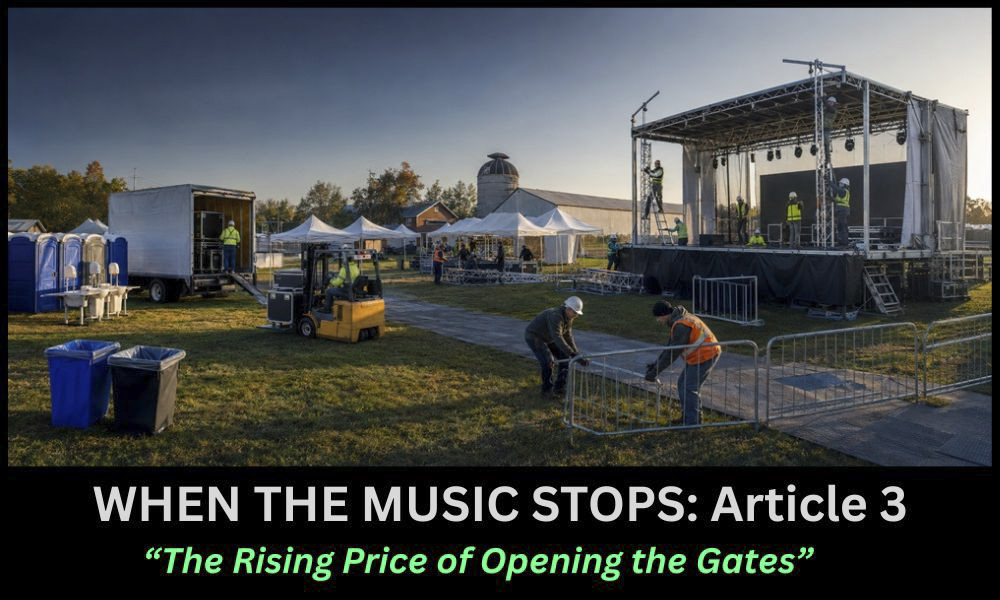
Days before the public arrives, an empty field, park or Main Street begins to change.
Trucks deliver tents, fencing and portable washrooms. Crews assemble stages and run electrical cables. Vendors are assigned spaces. Barricades appear at intersections. Waste containers, handwashing stations and directional signs are positioned throughout the grounds.
The organizer must provide many of the things a permanent community takes for granted:
- Roads and travel routes
- Electricity and lighting
- Drinking water
- Washrooms and sanitation
- Waste collection
- Food service
- Security
- First aid
- Emergency access
- Public information
- Accessible facilities
- Places to sit, rest and find shade
Then, after operating for only a day or weekend, the temporary community must be dismantled. Equipment is removed, waste collected and the land restored.
Visitors may see an open public park filled with tents and assume the location costs very little. In reality, the absence of permanent event infrastructure can make the site more expensive. Nearly everything required to transform it into a safe and welcoming gathering place must be rented, transported, installed, inspected and removed.
The gates have not yet opened, but the bills have already begun.
THE STAGE IS ONLY THE BEGINNING
Entertainment is one of the most visible expenses.
A performance may require:
- Artist or performer fees
- Travel
- Accommodation
- Meals and hospitality
- Stage rental
- Sound and lighting
- Backline equipment
- Technical crews
- Electrical service or generators
- Security
- Insurance
- SOCAN and Re:Sound licensing
- Dressing rooms or private preparation areas
The audience sees the performer. It may not realize how many people and services were required to put that performer safely on stage.
Production costs for independent festivals have risen as equipment, transportation, skilled labour and fuel have become more expensive. Experienced audio engineers, riggers, production managers and technicians are specialized professionals, and their availability can be limited during Ontario’s short outdoor festival season.
Smaller festivals compete for many of the same suppliers as large concerts, municipal celebrations and corporate events. Their bargaining power is limited, particularly when several nearby events take place on the same weekend.
A committee may reduce entertainment spending, but it cannot simply eliminate safe staging, electrical systems or qualified technical support.
THE PRICE OF KEEPING PEOPLE SAFE
Security has become one of the fastest-growing and most sensitive event expenses.
Organizers must consider:
- Crowd movement
- Emergency access
- Alcohol service
- Stage and backstage security
- Traffic control
- Lost children
- Vehicle access
- Overnight equipment protection
- Conflict and harassment
- Severe-weather evacuation
- Threat assessment
- Barriers protecting pedestrian areas
Depending on the event, municipalities or police services may require private security, paid-duty officers, municipal by-law officers or a combination of personnel.
Paid-duty services often carry minimum booking periods. Peel Regional Police, for example, applies a three-hour minimum charge per officer, while the number of officers required is assessed according to the event and duties involved.
A municipality may also require increased security based on anticipated attendance or risk. Aurora’s 2025 third-party event policy specifies paid security or paid-duty officers for medium- and high-risk events, with security expenses being the responsibility of the permit holder.
Toronto created a Special Events Stabilization Initiative specifically because festivals were being severely affected by increasing health, safety and security expenses. The program identifies security, crowd management, insurance and health-and-safety measures among the rising costs threatening local events.
In 2025, Toronto made an additional $750,000 available to event organizers for security, raising that year’s stabilization initiative to $2.1 million.
That assistance was significant, but its necessity reveals the scale of the problem: essential safety costs had increased beyond what many festival budgets could absorb.
WASHROOMS, WATER AND THE ESSENTIALS NOBODY SPONSORS
Portable washrooms are unlikely to appear on a festival poster, yet their number, placement, cleanliness and accessibility can shape the entire visitor experience.
The Township of Champlain’s special-event requirements illustrate the planning involved. Its guidance establishes washroom quantities based on anticipated attendance, requires accessible units and calls for handwashing stations in relation to the number of toilets. An event expecting more than 2,000 people may require at least 20 toilets, with additional units as attendance increases. Township of Champlain
Organizers may also need:
- Regular cleaning and pumping
- Handwashing or sanitizing stations
- Potable water
- Accessible travel routes
- Lighting
- Wastewater management
- Baby-changing facilities
- Additional units near food and beverage areas
- Secure placement that does not block emergency access
Similar costs apply to waste and cleaning.
Crowds create garbage, recycling, food waste and spills. Eating areas need tables, shade, cleaning and continual attention. Vendors require appropriate disposal arrangements. The grounds must remain attractive during the event and be returned in acceptable condition afterward.
Visitors remember unclean washrooms, overflowing waste containers and dirty eating areas long after they forget a particular performance.
Cleanliness is not a minor operational detail. It is part of the event’s reputation.
ACCESSIBILITY IS PART OF THE EVENT—NOT AN OPTIONAL ADDITION
An event should be welcoming to seniors, families with strollers and people with disabilities.
Meaningful accessibility may require:
- Accessible parking
- Firm and level travel routes
- Appropriate entrance widths
- Accessible washrooms
- Seating and rest areas
- Shade
- Hydration stations
- Accessible viewing areas
- Clear directional signs
- Accessible stages or presentation areas
- Support-person policies
- Service-animal access
- Quiet or sensory-friendly areas
- Accessible websites and ticketing
- Staff and volunteer training
Some improvements carry direct costs. Others require better planning and consultation.
Accessibility should never be framed as an unnecessary expense imposed on festivals. It expands participation, improves visitor comfort and reflects the community values events are meant to celebrate.
The real concern is that organizers are often expected to add accessibility improvements to already strained budgets without dedicated funding or suitable permanent infrastructure.
Businesses and governments frequently sponsor entertainment because it is visible. Accessibility, shade, seating and hydration deserve the same sponsorship attention. They directly determine who can attend, how long visitors can remain and whether the experience is truly inclusive.
THE COST OF CLOSING A STREET
A street festival may appear to use space the public already owns. But safely converting a working road into an event site can require:
- Road-closure permits
- Traffic-management plans
- Barricades and signs
- Paid-duty officers
- Security personnel
- Notification of residents and businesses
- Emergency vehicle lanes
- Parking restrictions
- Accessible detours
- Transit changes
- Setup and removal crews
- Municipal inspections
Businesses inside the closure must continue receiving deliveries or emergency access. Residents may need to reach their homes. Intersections must be managed. Vehicles must be prevented from accidentally or deliberately entering pedestrian spaces.
Toronto street-festival organizers reported in June 2026 that rising operating costs were placing increasing pressure on their budgets. Do West Fest’s managing director described the event as one of the city’s larger festivals but one operating with a relatively small budget.
Road closures can create tremendous public experiences, but “using the street” is not free.
THE HIDDEN EFFECT OF LABOUR SHORTAGES
Many festivals were historically built around donated labour and informal community relationships. A local company loaned equipment. A tradesperson helped install it. Volunteers handled setup and cleanup. Municipal employees provided assistance as part of a community partnership.
Some of those relationships remain, but event operations have become more technical and regulated.
Organizers increasingly require people with specialized abilities:
- Electricians
- Sound and lighting technicians
- Engineers
- Equipment operators
- Security professionals
- First-aid providers
- Traffic-control personnel
- Food-safety professionals
- Accessibility consultants
- Ticketing and technology support
These people deserve to be paid appropriately. The difficulty is that event budgets do not always reflect the true cost of professional work.
Volunteer labour remains essential, but volunteers cannot be expected to perform regulated or specialized duties for which they are not trained.
The result is a difficult transition. Events must become more professionally operated without necessarily possessing professional-level revenue.
TRANSPORTATION, FUEL AND DISTANCE
Ontario’s geography adds another layer of expense.
Equipment, performers, midway operators, food vendors and technical crews may travel considerable distances. Rural and northern events can face:
- Delivery surcharges
- Higher fuel costs
- Overnight accommodation
- Limited local supplier choices
- Minimum rental periods
- Longer setup schedules
- Increased transportation risk
- Difficulty replacing equipment at short notice
An urban festival may have several suppliers nearby but face higher policing, security and road-closure expenses. A rural event may have access to land and community support but pay substantially more to bring equipment and services to the site.
There is no single Ontario cost model. Geography shifts where the pressure appears.
THE DIGITAL EVENT IS NOT FREE EITHER
Modern visitors expect information to be immediate and accurate.
They want:
- A mobile-friendly website
- Online ticketing
- Digital schedules
- Social-media updates
- Email communication
- Cashless payment
- Parking information
- Accessibility details
- Weather and emergency notices
- Answers to questions before arrival
These systems can improve efficiency and reduce some administrative work, but they create expenses:
- Website development and hosting
- Ticketing and payment fees
- Credit-card charges
- Software subscriptions
- Technical support
- Digital advertising
- Graphic design
- Cybersecurity
- Data and privacy management
- On-site internet or cellular systems
A festival can no longer depend entirely on a poster in a store window. Yet smaller events are competing online with attractions and entertainment companies possessing much larger advertising budgets.
MARKETING COSTS RISE WHILE FREE REACH SHRINKS
Social media was once viewed as a nearly free way to promote a community event. It remains valuable, but unpaid posts may reach only a portion of an event’s followers.
Organizers may need to invest in:
- Social-media advertising
- Search advertising
- Email systems
- Photography and video
- Media relations
- Website content
- Printed guides
- Road signs
- Community posters
- Tourism listings
- Radio or local media
Marketing cannot wait until every other bill is paid. Without effective promotion, the event may not generate the attendance needed to cover its costs.
The financial dilemma is obvious: reduce marketing to save money, and the event may lose the visitors required to survive.
WHEN TRADITION BECOMES AN EXPENSE
Long-running events often carry programming because it has always been included.
A particular attraction, parade, ceremony or entertainment feature may be loved by a loyal group but have become extremely expensive. Organizers may hesitate to question it because they fear criticism or believe changing it would dishonour the event’s history.
Tradition matters. It gives an event identity and connects generations.
But every established event must periodically ask:
- Does this activity still serve our purpose?
- Does the audience continue to value it?
- Can we afford it?
- Could it be delivered differently?
- Is another program being sacrificed to preserve it?
- Are we keeping it because it matters—or because discussing change is uncomfortable?
The objective is not to remove the heart of the event. It is to ensure that the heart does not become buried beneath practices the organization can no longer sustain.
A VIEW FROM THE FESTIVAL ROAD
One of the most dangerous phrases in event management is:
“We have always done it this way.”
The phrase often comes from good people who have given years of service. They are protecting something that has worked and something of which they are justifiably proud.
But costs, audiences, volunteers and expectations change.
An activity that was once supported by donated equipment may now require a commercial rental. A volunteer task may now need a qualified professional. A program that once attracted visitors may no longer distinguish the event. A three-day festival may discover that one day consistently loses money.
Organizers should respect tradition, but they must never allow past success to end a discussion about the future.
The most responsible question is not, “How do we keep everything?”
It is:
“What must we preserve—and what must change so the event itself can survive?”
REASONS FOR HOPE
Rising expenses do not automatically mean the end of community festivals.
Events can respond creatively:
- Several organizations can share equipment.
- Municipalities can purchase commonly required barriers or accessibility equipment.
- Festivals can coordinate dates and supplier deliveries.
- Sponsors can support washrooms, hydration, shade, volunteers or security.
- Multi-year contracts can improve predictability.
- Equipment can be purchased when repeated rentals become more expensive.
- Events can shorten hours or reduce unproductive days.
- Programming can be concentrated into a stronger schedule.
- Partnerships can provide professional expertise.
- Technology can reduce repetitive administrative work.
- Better site design can reduce staffing and equipment needs.
- Regional organizations can provide shared training and templates.
The City of Toronto’s stabilization initiative also demonstrates that governments can respond when essential safety expenses threaten the future of community events.
Most importantly, organizers can begin examining costs earlier. A difficult decision made twelve months before an event offers more options than the same decision made twelve days before opening.
KEEPING THE CELEBRATION ALIVE
PROVINCIAL AND MUNICIPAL ACTION
Governments and municipalities can help by:
- Providing multi-year operational assistance
- Funding essential infrastructure, not only programming
- Coordinating permit and departmental requirements
- Identifying total municipal costs early
- Maintaining inventories of barriers and event equipment
- Providing suitable electricity, water and waste services at designated sites
- Investing in accessible public-event infrastructure
- Supporting group purchasing
- Helping events develop safety and emergency plans
- Avoiding unexpected fees late in the planning process
- Recognizing in-kind municipal services as strategic investment
CORPORATE AND COMMUNITY ACTION
Sponsors and community partners can support:
- Accessible washrooms
- Seating and shade
- Hydration stations
- Volunteer meals and clothing
- First aid
- Waste reduction
- Transportation
- Security
- Technology
- Site restoration
These may not have the glamour of a headline stage, but they make the celebration possible.
EVENT ORGANIZATION ACTION
Organizers should:
- Determine the full cost of every activity
- Obtain estimates early
- Include setup and removal in supplier discussions
- Review contracts carefully
- Document donated goods and volunteer labour
- Compare rental and ownership costs
- Negotiate multi-year arrangements where appropriate
- Build realistic contingencies
- Examine profitable and unprofitable days
- Share services with nearby events
- Separate essential costs from desirable additions
- Protect accessibility and safety when reducing budgets
- Right-size the event before financial pressure forces cancellation
- Review every traditional activity against purpose, audience and affordability
CUTTING COSTS WITHOUT CUTTING THE HEART
There is a danger in every cost-reduction exercise. An event can remove so much programming, comfort and character that visitors no longer have a reason to attend.
The purpose is not to make the event as inexpensive as possible.
It is to invest limited resources in the things that matter most:
- The event’s purpose
- Its distinctive identity
- Visitor safety
- Accessibility
- Cleanliness
- Community participation
- The experiences audiences value
- The people who make it possible
A smaller event that delivers those things well may be stronger than a large event struggling to meet its obligations.
BEFORE THE FIRST VISITOR ARRIVES
By opening morning, the temporary community is ready.
The stage has been inspected. The sound system is operating. Washrooms are in place. Travel routes are clear. Volunteers have their instructions. Security personnel know their posts. Vendors are prepared. Waste containers, signs, seating and first-aid stations are waiting.
Visitors enter and see a celebration.
Organizers see months of commitments, thousands of decisions and a budget already carrying nearly all the risk.
Ontario’s festivals do not need lower standards. They need a more realistic understanding of what safe, accessible and professional events now cost—and partnerships capable of sharing that responsibility.
If communities want the gates to keep opening, they must recognize the enormous amount of work and investment required before anyone walks through them.
COMING IN PART FOUR
Rising operating costs are only part of the responsibility carried by today’s organizers. Insurance, permits, public health, alcohol service, accessibility, temporary structures and emergency planning create an increasingly complicated web of obligations.
In Part Four, The Weight of Responsibility, we examine how Ontario can maintain necessary public protections while making the regulatory and insurance system more understandable and manageable for volunteer-operated events.
EXPLORE THE SERIES
Previous Article: Part Two — The Financial Ground Is Shifting
Series Home: When the Music Stops — Coming Soon
Next Article: Part Four — The Weight of Responsibility — Coming Soon
Published by FES Tourism, operating as Ontario Visited and Ontario Agritourism.
SOURCES
City of Toronto — Special Events Stabilization Initiative
CityNews Toronto — Rising street-festival costs and event security assistance
Peel Regional Police — Paid-duty officer requirements
Town of Aurora — Third-Party Special Events Policy
Township of Champlain — Special-event washroom, accessibility and sanitation requirements