












WHEN THE MUSIC STOPS
“The Fight to Save Ontario’s Festivals and Events”
PART TWO OF TEN
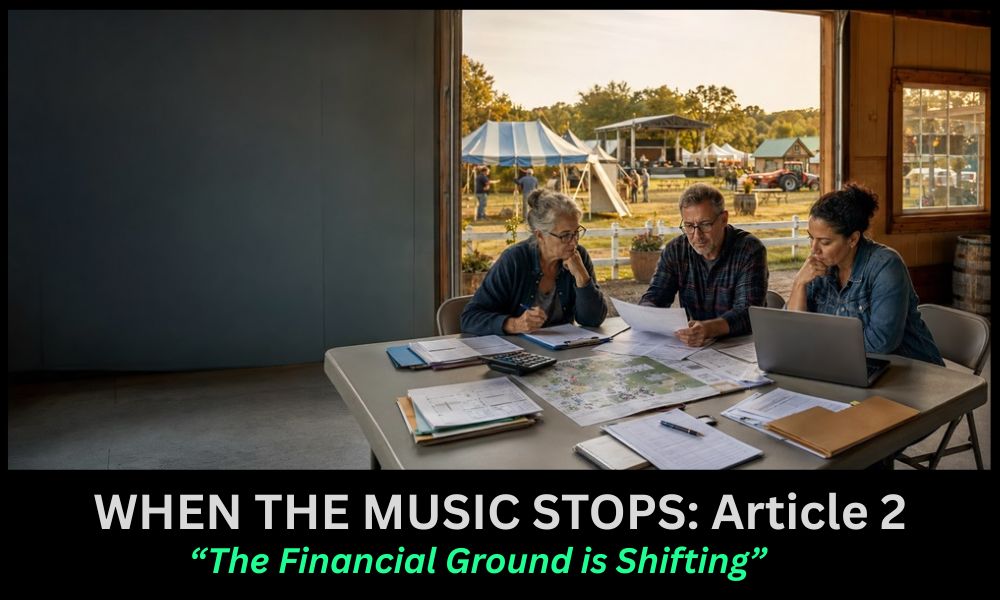
THE FINANCIAL GROUND IS SHIFTING
“Why Successful Ontario Festivals Can Still Be Financially Fragile”
Ontario Perspectives • Special Investigative Series
EXECUTIVE SUMMARY
Ontario continues to make a significant investment in its festivals and events. Through Experience Ontario 2026, the provincial government committed more than $20 million to support nearly 400 events across the province. Municipalities, businesses and community organizations also contribute grants, services, sponsorships and volunteer labour.
That support matters—but it does not provide every event with financial security.
Government programs are competitive, applications require considerable time and funding is not guaranteed, even for previous recipients. Corporate sponsorship can change suddenly as businesses adjust budgets, marketing priorities or community investments. Municipal support varies widely. Meanwhile, organizers may need to sign contracts and pay deposits months before funding decisions, ticket revenue or vendor payments arrive.
Small, rural, cultural and volunteer-operated events face an additional challenge. Their greatest contribution may be community pride, tradition, inclusion or local participation, yet funding programs frequently give priority to tourism growth, visitor spending, increased programming and measurable economic results.
An event can attract thousands of people, generate business throughout its community and still finish the weekend with very little money—or a loss. Crowds do not necessarily produce stability.
The solution is not simply “more funding.” Ontario needs more predictable support, funding streams that recognize different kinds of events, assistance with organizational capacity and greater acceptance of reasonable financial reserves. Event organizers must also understand their true costs, diversify revenue, plan for unsuccessful applications and be willing to right-size programming before financial weakness becomes an irreversible crisis.
ABOUT THIS SERIES
When the Music Stops is a ten-part FES Tourism special series examining the pressures confronting Ontario’s festivals and events. From funding, insurance and regulations to volunteers, weather, land use and the loss of Festivals and Events Ontario, the series explores what is at risk—and what must be done to protect the celebrations that help define Ontario.
THE BUDGET BEFORE THE CELEBRATION
The festival grounds are still empty when the first major bills come due.
The entertainer may require a deposit. The tent company wants confirmation. Advertising must begin. Insurance needs to be arranged. Permits, equipment and professional services have to be secured. Contracts cannot wait until visitors arrive at the gate.
Yet many of the revenues intended to pay those expenses remain uncertain.
A government grant application may still be under consideration. A sponsor that participated last year has not confirmed its return. Vendor payments are incomplete. Advance ticket sales have only begun. The organizing committee may be planning an event worth tens or hundreds of thousands of dollars while possessing only a fraction of that amount in available cash.
This is the financial reality visitors rarely see.
When the gates finally open and the grounds fill with people, the event may look successful. Restaurants may be busy. Vendors may report strong sales. Hotels may welcome visitors. Photographs may show crowds stretching from one end of the site to the other.
But none of those images reveals whether the organizing committee can pay every bill—or whether enough money will remain to begin planning next year.
A crowded event and a financially sustainable event are not necessarily the same thing.
ONTARIO IS INVESTING—AND THAT MATTERS
Any fair examination must acknowledge the public support that exists.
In April 2026, the Ontario government announced an investment of more than $20 million through Experience Ontario to support nearly 400 festivals and events. The province described the program as helping communities attract visitors, strengthen local economies and showcase Ontario’s culture and experiences.
Experience Ontario 2026 also introduced a Capacity Building stream for eligible events new to the program, alongside the Established Events stream. Its objectives include encouraging travel, increasing visitor spending, creating employment and raising Ontario’s profile.
This is substantial and valuable support. Without government investment, many events would be smaller, less accessible or unable to proceed.
The problem is not that Ontario provides no funding.
The problem is that annual, competitive funding cannot offer the financial certainty required to sustain an event organization over the long term.
ELIGIBLE DOES NOT MEAN FUNDED
Experience Ontario’s guidelines are direct: it is a competitive program, and there is no guarantee of funding, including for past recipients.
That is understandable. Governments have limited resources, program objectives and a responsibility to assess applications. An organization should not automatically receive funding forever because it was funded previously.
However, the uncertainty creates serious planning difficulties.
An organizer may have to:
- Prepare programming before knowing the available budget
- Reserve performers and suppliers months in advance
- Pay deposits
- Estimate attendance and visitor spending
- Confirm partnerships
- Prepare advertising
- Recruit volunteers
- Apply for permits
- Make commitments to vendors
- Plan accessibility and safety measures
If funding is reduced or denied, the committee must make rapid changes after much of the planning has already occurred.
A long-established event may consequently find itself in a dangerous pattern: it builds its budget around anticipated funding, receives less than expected and then spends the following year trying to recover the difference.
A grant should never be recorded as confirmed revenue until it is formally approved. Yet without including anticipated support, an organization may be unable to plan anything meaningful.
That contradiction places much of the risk on the organizer.
THE APPLICATION ITSELF HAS A COST
Grant funding is not free money. It requires organizational capacity.
A serious application may involve:
- Program research
- Detailed budgets
- Attendance records
- Visitor information
- Marketing plans
- Economic-impact estimates
- Supplier quotations
- Letters of support
- Partnership confirmations
- Governance information
- Financial statements
- Outcome measurements
- Final reporting
Large organizations may employ staff or professional grant writers. A rural fair, neighbourhood celebration or small cultural festival may depend on one volunteer completing the application during evenings and weekends.
The strongest applicants are often those with the staff, data and administrative systems needed to present a polished case. Events with the greatest need may have the least capacity to compete successfully.
This does not mean standards should be abandoned. Public money must be awarded responsibly. It means funding programs should recognize that the ability to write an excellent application is not always the same as the ability to deliver an excellent community event.
WHEN TOURISM VALUE AND COMMUNITY VALUE ARE DIFFERENT
Experience Ontario is designed to support festivals and events with tourism economic impact. Its focus on travel, visitor spending, employment, partnerships and provincial profile is appropriate for a tourism program.
However, not every important event is primarily a tourism event.
A small-town parade may not generate overnight stays. A rural fall fair may serve local families while preserving agricultural knowledge. A community winter carnival may have modest visitor spending but provide one of the few occasions when residents gather during the coldest part of the year. A cultural celebration may strengthen identity, belonging and understanding even if most attendees live nearby.
These events still create value:
- Community pride
- Cultural preservation
- Youth participation
- Leadership development
- Social connection
- Volunteer experience
- Exposure for local producers
- Charitable fundraising
- Resident satisfaction
- A stronger sense of place
If tourism programs are expected to fund all types of events, organizers may feel pressured to describe every celebration primarily through visitor numbers and spending.
Ontario needs tourism-focused funding—but it also needs funding that recognizes community infrastructure and social value.
The question should not always be:
How many tourists did the event attract?
Sometimes it should be:
What would this community lose if the event disappeared?
THE CORPORATE SPONSORSHIP SAFETY NET IS WEAKENING
Corporate sponsorship has helped keep many Ontario events affordable or free. It has funded stages, entertainment, children’s activities, transportation, accessibility, fireworks, volunteer programs and promotional campaigns.
But sponsorship is not guaranteed income.
Companies may withdraw because of:
- Reduced marketing budgets
- New corporate priorities
- Ownership or management changes
- Economic uncertainty
- Centralized decision-making
- Concerns about controversial issues
- Changes in audience strategy
- A preference for larger, more measurable opportunities
- Increased competition from charities, hospitals, sports and other community causes
The withdrawal can happen even when the event has met its obligations and delivered substantial recognition.
Pride Toronto’s recent experience illustrates how quickly sponsorship conditions can change. Several major companies withdrew support, creating concern about the festival’s ability to sustain programming and remain accessible.
Pride festivals across Canada subsequently called for additional public support as corporations reduced their involvement.
The circumstances surrounding Pride sponsorship are distinct, but the underlying financial lesson applies throughout the sector:
Revenue that depends on another organization’s annual priorities can disappear for reasons entirely outside the event’s control.
SMALL EVENTS FACE A DIFFERENT SPONSORSHIP MARKET
A large event can offer substantial attendance, media exposure, hospitality and digital measurement. A small community festival may offer something less easily counted but deeply valuable: trust, local recognition and direct connection.
Local businesses often understand that value. They know the organizers, serve the attendees and benefit when the community is busy.
However, the same local businesses face:
- Higher operating costs
- Staffing shortages
- Numerous sponsorship requests
- Limited promotional budgets
- Pressure to demonstrate a financial return
- Their own uncertainty about the future
Small event committees may also lack professional sponsorship materials, audience research or sales experience. Volunteers sometimes approach businesses only weeks before the event, asking for money without clearly explaining the partnership’s value.
The result is frustration on both sides. Organizers feel that businesses no longer support the community. Businesses feel they are continually asked to donate without receiving a clear proposal, adequate notice or meaningful follow-up.
Sponsorship must become a partnership rather than an annual request for help.
THE MUNICIPAL DIFFERENCE
Municipal support can determine whether an event remains viable.
That support may include cash, but it can also involve:
- Reduced or waived facility rental
- Park preparation
- Barricades and traffic equipment
- Waste removal
- Electrical service
- Staff coordination
- Marketing
- Police, fire or emergency assistance
- Storage
- Public transit
- Equipment
- Road-closure services
In-kind assistance can be more valuable than a small grant because it removes expenses that the organizer would otherwise have to pay.
Municipal support varies considerably. Some communities treat established events as economic-development and community-building partners. Others treat them mainly as applicants renting public space and consuming municipal services.
Municipalities also face legitimate pressures. Staff time, policing, waste collection and park restoration cost money. Taxpayers cannot be expected to absorb every expense for every event.
The solution begins with measuring value honestly. If an event supports local businesses, attracts visitors, creates volunteer opportunities and strengthens the community’s identity, municipal assistance is not simply a subsidy. It is an investment in community development.
WHEN FREE DOES NOT MEAN COSTLESS
Free festivals can be among the most inclusive community experiences. No family must decide whether it can afford admission. Residents can participate for an hour or an entire day. Children, seniors and people with limited incomes can share the experience.
But free admission removes one of the event’s most direct sources of revenue.
A free event may depend heavily on:
- Government grants
- Municipal support
- Sponsorship
- Vendor fees
- Donations
- Lotteries or fundraising
- Beverage or merchandise sales
If any one of those sources declines, the event has few immediate alternatives. Introducing admission may undermine its purpose, reduce attendance or create new fencing, ticketing and security expenses.
Free events therefore require particularly strong partnerships and diversified funding. Their accessibility is a public benefit, but someone must still pay for the stage, insurance, washrooms, security, artists, power and cleanup.
THE CASH-FLOW TRAP
An event can finish the year with balanced financial statements and still experience a cash-flow crisis.
Consider the timing:
- Deposits may be due six to twelve months before the event.
- Grant decisions may arrive later than expected.
- Sponsors may pay after invoicing or shortly before the event.
- Vendors may delay applications.
- Ticket revenue may increase only during the final weeks.
- Some grants may require final reporting before the last payment.
- Weather can reduce gate revenue on the day it is needed most.
The budget may show that total revenue will cover total expenses, but the bank account may not contain enough money when payments are due.
Organizations without reserves may use credit, delay suppliers, reduce programming or depend on personal advances from directors. Those approaches hide the real financial weakness and place unacceptable pressure on volunteers.
A financially sustainable event needs both a balanced budget and enough working capital to operate safely.
A VIEW FROM THE FESTIVAL ROAD
Over many years of working with festivals and community organizations, I have learned that attendance can be deceptive.
Organizers naturally feel encouraged when the grounds are full. Crowds create energy, satisfy sponsors and reassure volunteers that their work mattered.
But a successful-looking event can still be losing money.
Some activities remain in the program because they are popular, even though their cost has risen far beyond the revenue or sponsorship they produce. Admission rates remain unchanged because organizers fear public criticism. Vendor fees are kept artificially low. Complimentary admissions expand. An unsuccessful day is supported by a profitable one without anyone examining whether the full schedule still makes sense.
Eventually, the organization discovers that it has been using past reserves to create the appearance of continued success.
Attendance matters—but responsible financial management determines whether there will be another event.
REASONS FOR HOPE
Ontario is not beginning from nothing.
The province already makes a substantial investment through Experience Ontario. Municipalities understand the value of community celebrations. Businesses continue to support events that offer meaningful partnerships. Residents attend, donate and volunteer.
There are also signs that governments recognize the need for different approaches. Experience Ontario 2026 created separate Established Events and Capacity Building streams. Toronto has considered a broader strategy intended to help stabilize festivals as costs increase and sponsorship becomes less certain.
Events themselves possess more options than they sometimes realize:
- Multi-year sponsorships
- Program-specific partnerships
- Donations and memberships
- Premium experiences
- Merchandise
- Year-round activities
- Shared equipment
- Regional collaborations
- More accurate pricing
- Smaller or shorter programming
- Digital fundraising
- Improved grant planning
- Better economic and community-impact measurement
Financial renewal does not always require dramatic growth. Sometimes it begins by understanding what the event can afford and concentrating resources on what the community values most.
KEEPING THE CELEBRATION ALIVE
A stronger financial future requires action from several directions.
PROVINCIAL ACTION
Ontario should consider:
- Two- or three-year funding agreements for proven events
- Separate funding streams for tourism events and community celebrations
- Support for organizational capacity and professional administration
- Recognition of volunteer contributions
- Earlier funding decisions
- Emergency stabilization assistance
- Funding for accessibility, succession and risk planning
- Permission for responsible nonprofit reserves
- Simpler applications for smaller funding requests
Multi-year funding should not eliminate accountability. Organizations would still report results and demonstrate responsible management. It would give qualified events enough certainty to plan intelligently.
MUNICIPAL ACTION
Municipalities can help through:
- Predictable multi-year support
- Coordinated application processes
- In-kind services
- Transparent fees
- Early confirmation of venue access
- Assistance measuring local impact
- Event coordinators who understand multiple departments
- Recognition of established events in tourism and economic-development planning
CORPORATE ACTION
Businesses can strengthen events by offering:
- Multi-year partnerships
- Employee volunteer programs
- Professional expertise
- In-kind products and services
- Accessibility sponsorships
- Volunteer-support sponsorships
- Transportation, waste or hydration partnerships
- Earlier funding decisions
EVENT ORGANIZATION ACTION
Organizers must also accept difficult responsibilities:
- Never treat an application as confirmed funding
- Prepare a reduced budget before it is needed
- Understand cash flow, not only the annual budget
- Identify the true cost of every program area
- Measure profitable and unprofitable activities
- Diversify revenue
- Review admission and vendor pricing
- Build reserves
- Improve sponsorship proposals and reporting
- Approach partners earlier
- Avoid depending excessively on one grant or sponsor
- Right-size the event
- Stop programming that no longer serves its purpose
- Share financial information clearly with the board
Most importantly, financial discussions must take place before the organization reaches a crisis.
Financial difficulty is not an admission of failure. Refusing to discuss it can become one.
A FOUNDATION THAT MUST HOLD
Festivals generate benefits far beyond their own bank accounts. They bring customers to businesses, create work for suppliers, provide stages for artists and give communities reasons to gather.
But goodwill cannot pay an invoice. Tradition cannot replace working capital. A crowd cannot guarantee that next year’s deposits will be available.
Ontario’s events need funding systems that recognize their economic and community value. They also need organizers willing to look beyond attendance photographs and ask difficult questions about affordability, dependency, reserves and risk.
The financial ground may be shifting, but events are not powerless.
With more predictable public support, stronger partnerships, honest budgeting and a willingness to adjust before reserves disappear, many financially vulnerable events can recover.
The objective should not be to fund every event forever or protect every program from change.
It should be to ensure that events worth preserving are given a fair opportunity to become financially strong enough to preserve themselves.
COMING IN PART THREE
Funding may determine what an event can afford, but the cost of producing the celebration continues to rise before the first visitor arrives.
In Part Three, The Rising Price of Opening the Gates, we examine entertainment, equipment, security, policing, washrooms, accessibility, labour, marketing and the many expenses hidden behind a single day of celebration.
EXPLORE THE SERIES
Previous Article: Part One — More Than a Day of Celebration
Series Home: When the Music Stops — Coming Soon
Next Article: Part Three — The Rising Price of Opening the Gates — Coming Soon
Published by FES Tourism, operating as Ontario Visited and Ontario Agritourism.
SOURCES
Government of Ontario — Experience Ontario 2026 program information and funding announcement
Ontario Ministry of Tourism, Culture and Gaming — Experience Ontario 2026 Application Guide
Canadian Live Music Association — Ontario’s 2026 investment in festivals and events
Toronto Today — Toronto festival-support strategy
The Canadian Press — Corporate sponsorship reductions affecting Canadian Pride festivals
The Guardian — Pride Toronto corporate sponsorship losses