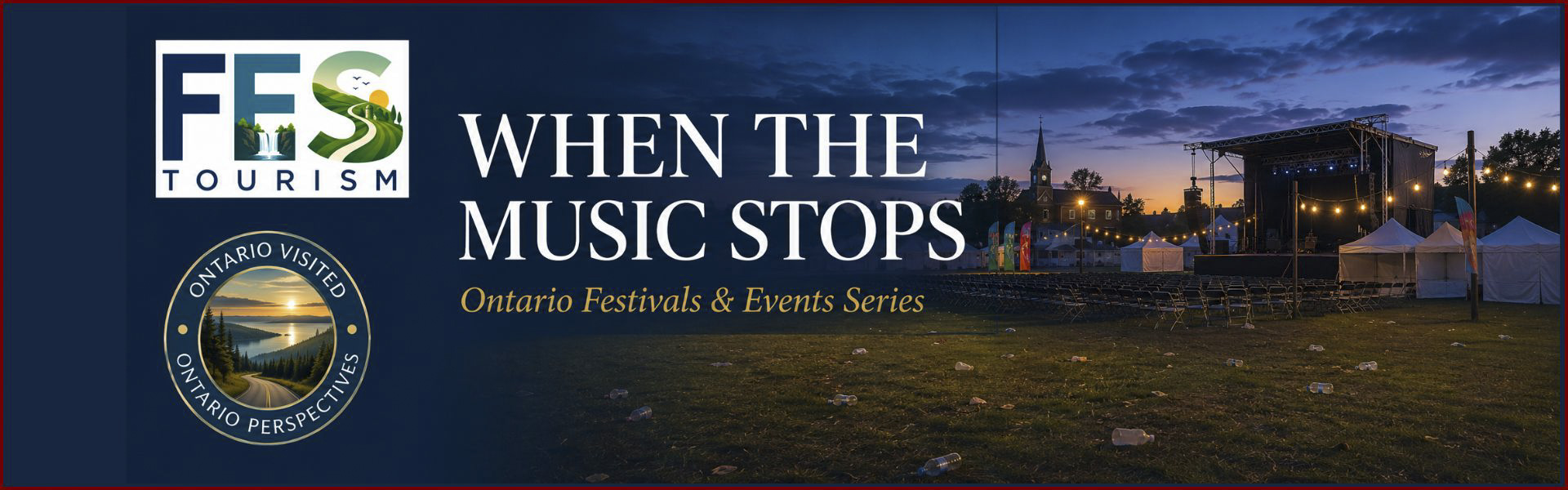













WHEN THE MUSIC STOPS
“The Fight to Save Ontario’s Festivals and Events”
PART TEN OF TEN
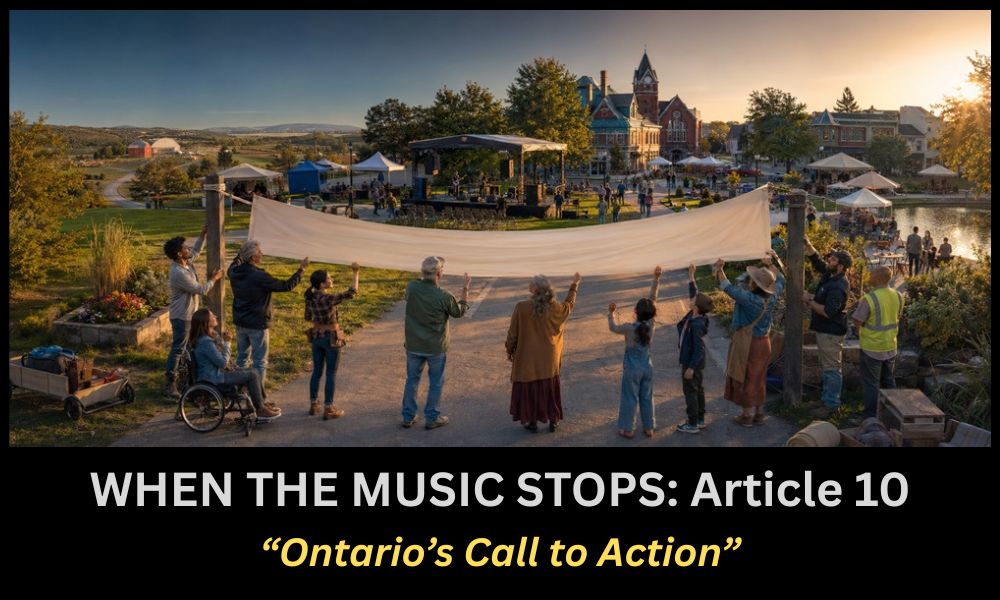
Ontario’s Call to Action
“If Festivals Are the Heart of Our Communities, We Must Decide to Keep That Heart Beating”
Ontario Perspectives • Special Investigative Series
Executive Summary
Ontario’s festivals, fairs and community events have reached a turning point.
They remain among the province’s most visible expressions of community identity, cultural heritage, volunteerism and civic pride. They attract visitors, support local businesses, create employment, provide opportunities for artists and producers, and develop future community leaders.
Yet the organizations producing them are being weakened by unstable funding, rising costs, complex regulations, unaffordable insurance, volunteer exhaustion, leadership succession failures, extreme weather, insecure event sites and the loss of provincial industry representation.
These pressures are not temporary inconveniences. Together, they threaten the survival of events that took generations to build.
Ontario has continued to invest in festivals, including more than $20 million through Experience Ontario 2026 to support nearly 400 events. That investment is valuable, but annual programming grants alone cannot resolve structural problems.
Ontario needs a coordinated festival-survival strategy.
This final article calls for twelve actions:
- Recognize festivals and significant event sites as community infrastructure.
- Establish an Ontario Festival and Event Sustainability Roundtable.
- Rebuild an independent provincial voice for the broader festival sector.
- Conduct an independent examination of Festivals and Events Ontario’s closure.
- Replace short-term project dependency with multi-year operating and resilience funding.
- Create an emergency stabilization program for events facing extraordinary disruption.
- Convene an insurance and risk-management working group.
- Simplify and coordinate regulatory and municipal requirements.
- Invest in volunteers, paid professional support and leadership succession.
- Develop regional shared-service hubs.
- Protect fairgrounds, parks and other important event spaces.
- Publish an annual State of Ontario Festivals and Events Report.
Ontario’s agricultural fairs already possess a dedicated and comparatively stable provincial organization through the Ontario Association of Agricultural Societies. OAAS should remain the principal voice for agricultural societies and become an important partner in areas where fairs and festivals face common pressures.
The objective is not to save every event exactly as it currently exists. Some need to become smaller. Some need new leadership, renewed purpose or different programming. A few may have completed their natural life.
Most, however, should not be allowed to disappear simply because governments, funders and communities failed to act before a manageable problem became a final crisis.
The future of Ontario’s celebrations will not be secured by one grant, organization or volunteer.
It will be secured by a collective decision that they are worth saving.
About This Series
When the Music Stops has examined the pressures threatening Ontario’s festivals, fairs and community events—and the actions that could help them survive.
The series began with a simple belief: these gatherings are not merely entertainment.
They generate economic activity, preserve culture and history, connect residents, support local businesses, develop volunteers and future leaders, and give communities a shared sense of identity.
When an event disappears, Ontario loses more than a date on its calendar.
A little of the community disappears with it.
The Music Has Not Stopped—Yet
Across Ontario, volunteers are still meeting in community halls.
They are applying for grants, calling sponsors, booking performers, painting signs, preparing exhibits, repairing fairground buildings and studying weather forecasts.
Municipal staff are reviewing site plans. Service clubs are organizing food booths. Artists, vendors, farmers, entertainers and suppliers are preparing for another season.
Families are still making memories.
The music has not stopped.
But behind many celebrations, the people responsible are asking difficult questions.
Can we afford another year?
Who will take over when the chair retires?
What happens if it rains all weekend?
Can we obtain insurance?
Will the municipality approve the site?
Will our volunteers return?
Does the community still understand why this event matters?
These questions are not evidence that organizers have lost their commitment.
They are evidence that commitment has been carrying too much of the burden for too long.
What This Series Has Revealed
The challenges facing festivals do not operate separately.
They reinforce one another.
Funding instability weakens everything else
When grants and sponsorships are uncertain, organizers delay contracts, reduce programming and avoid long-term investment. They may have no money for succession planning, professional advice, accessibility improvements or emergency preparation.
Regulation consumes limited capacity
Permits, inspections, road closures, alcohol requirements, food rules, policing, security and emergency plans may all be necessary.
The problem arises when requirements are inconsistent, duplicative, poorly coordinated or communicated too late for responsible planning.
Insurance has become both essential and difficult
Events need appropriate coverage to protect visitors, volunteers, municipalities and organizations.
When premiums rise, exclusions expand or cancellation coverage becomes unaffordable, smaller events may be asked to carry risks they do not fully understand and cannot financially absorb.
Volunteers are reaching their limits
Volunteers remain the foundation of countless events, but fewer people are willing or able to accept unlimited year-round responsibility.
The sector cannot continue treating exhaustion as proof of dedication.
Leadership succession is being postponed
Many events depend upon aging leaders whose knowledge has never been documented or transferred.
When those people leave, the event may lose its contacts, history, routines and confidence at the same time.
Weather is changing the risk
Rain has always affected outdoor events. Organizers must now prepare for extreme heat, wildfire smoke, intense rainfall, flooding, high winds and rapidly changing conditions.
One cancelled weekend can place an independent event in financial danger.
Event sites are insecure
Parks, streets, waterfronts, private properties and fairgrounds face competing demands. Without long-term agreements or community recognition, an event can lose the place that shaped its identity.
Some events have lost their purpose
Not every threat comes from outside.
An event can decline because its leadership resists change, its program becomes repetitive or its connection with the community weakens.
The broader festival industry lost its provincial voice
The cessation of Festivals and Events Ontario removed the principal dedicated association serving Ontario’s broader festival community.
The unanswered questions surrounding FEO’s closure are important, but so is the leadership and education vacuum it left behind.
These challenges form one connected crisis.
The response must be connected as well.
The First Decision: What Are Festivals?
Ontario must decide how it understands festivals and community events.
Are they temporary entertainment programs that receive support when funding is available?
Or are they part of the infrastructure that makes communities livable, distinctive and economically active?
Infrastructure is usually understood as something physical: roads, bridges, arenas, community halls and water systems.
Communities also depend upon social and cultural infrastructure.
They need organizations, traditions, gathering places and opportunities for people to work together. Festivals create that infrastructure temporarily but repeatedly.
They turn a street into a community dining room, a park into a concert hall, a fairground into a meeting place between rural and urban Ontario, and a waterfront into a shared civic stage.
They give newcomers a way to participate and longtime residents a reason to remember.
They are places where teenagers complete their first volunteer shifts, where emerging leaders learn to organize people and where local businesses meet visitors.
If festivals are treated only as temporary entertainment, their problems will continue to be addressed through temporary solutions.
If they are recognized as community infrastructure, long-term planning becomes possible.
Twelve Actions Ontario Should Take
-
Recognize Festivals as Community Infrastructure
The province and municipalities should formally recognize significant festivals, fairs and community events as cultural, tourism, economic and social infrastructure.
Recognition should not guarantee permanent funding for every event. It should require decision-makers to consider the full value of an event before reducing support, changing access to land or allowing it to disappear.
Municipal cultural plans, tourism strategies, economic-development plans and climate-adaptation programs should include festivals.
Important event sites should also be considered when infrastructure investments are made. Drainage, accessible pathways, electrical services, washrooms, water access, shade and emergency routes benefit the community beyond the event itself.
-
Establish an Ontario Festival and Event Sustainability Roundtable
Ontario should bring the sector together before more events reach crisis.
The roundtable should include:
- Community, cultural, music, heritage, food, arts and seasonal festivals.
- Municipal event representatives.
- Rural and northern organizers.
- Indigenous and multicultural event leaders.
- Tourism organizations.
- The Ontario Association of Agricultural Societies.
- Event suppliers and professionals.
- Insurers and risk specialists.
- Public-health and emergency-management representatives.
- Corporate sponsors and foundations.
- Educational institutions.
- Former FEO members and representatives.
Its mandate should be time-limited and practical.
Within one year, it should identify the sector’s most urgent needs, propose a new representation model, recommend funding and insurance reforms, and develop an implementation timetable.
The roundtable should not become another permanent discussion group.
Its purpose should be to produce action.
-
Rebuild an Independent Provincial Festival Voice
Ontario’s broader festival community needs a new provincial association or successor structure.
It should provide:
- Advocacy.
- Education and professional development.
- Regional networking.
- Industry research.
- Supplier and professional resources.
- Shared-service development.
- Awards and recognition.
- Leadership succession and mentorship.
- Government consultation.
- Crisis communication.
The organization must be independent enough to speak honestly to government while working constructively with it.
Its revenue should come from several sources, including affordable tiered membership, multi-year provincial support, training, supplier participation, partnerships and conference income.
Its governance should include transparent financial reporting, regional representation, leadership renewal, succession planning and meaningful accountability to members.
It should not attempt to replace OAAS. Agricultural societies already possess their own provincial organization. The two organizations should collaborate where their interests overlap while respecting their different mandates.
Sources: Ontario Association of Agricultural Societies; Tourism Industry Association of Ontario
-
Independently Examine FEO’s Closure
The industry cannot build confidently without understanding what happened to the organization that previously represented it.
An independent examination should consider:
- FEO’s financial condition.
- Board governance and reporting.
- Leadership transition.
- The timing of the decision to cease operations.
- Communication with members.
- Whether restructuring or emergency support was explored.
- The status of assets, records and intellectual property.
- The future of its awards, Top 100 designation and Hall of Fame.
- Lessons that should guide a successor organization.
The purpose should not be to damage reputations or assign blame without evidence.
It should be to establish facts, preserve valuable resources and prevent the next organization from repeating avoidable mistakes.
The full circumstances and questions are examined in the accompanying special report, What Happened to Festivals and Events Ontario?
-
Introduce Multi-Year Operating and Resilience Funding
Annual project grants are important, but they encourage short-term planning.
Festivals need funding that can also support:
- Core administration.
- Governance.
- Volunteer coordination.
- Professional advice.
- Strategic planning.
- Leadership succession.
- Accessibility.
- Technology.
- Audience research.
- Risk and emergency planning.
- Shared services.
- Financial and organizational renewal.
Multi-year funding should be available to events demonstrating public value, responsible governance and a credible plan.
Applications should be proportionate to the amount requested. A small volunteer festival should not face the same administrative burden as a major event seeking substantial public investment.
Funding decisions must also arrive early enough for organizers to plan responsibly.
In 2026, Ontario invested more than $20 million through Experience Ontario to support nearly 400 festivals and events. That investment demonstrates the province’s recognition of their economic and tourism importance.
The next step is to invest in the organizations beneath the programming.
Sources: Ontario investing more than $20 million in local festivals and events; Ontario Nonprofit Network—Nonprofit Sustainability
-
Create an Emergency Festival Stabilization Program
A strong event can be placed in danger by one extraordinary incident.
Wildfire smoke, flooding, severe storms, venue loss or another emergency may force cancellation after major expenses have been incurred.
An emergency stabilization program could provide temporary assistance when:
- The disruption was beyond the organizer’s reasonable control.
- The event had appropriate risk and financial plans.
- Commercial insurance was unavailable, unaffordable or insufficient.
- The event can demonstrate community significance.
- A recovery plan exists.
- Assistance is necessary to prevent permanent closure.
The program should not compensate events for ordinary poor planning or routine attendance risk.
It should ensure that one exceptional emergency does not erase decades of community work.
-
Convene an Insurance and Risk-Management Working Group
The province should bring organizers, municipalities, insurers, brokers, legal specialists and emergency professionals together to examine:
- Premium increases.
- Coverage exclusions.
- Cancellation and weather insurance.
- Municipal insurance requirements.
- Alcohol-related liability.
- Volunteer and board coverage.
- Temporary structures and equipment.
- Security expectations.
- Shared or pooled purchasing possibilities.
- Standardized risk-management resources.
- Plain-language policy information.
Not every insurance problem can be solved through government intervention. Claims experience, market capacity and the nature of individual events will continue to affect pricing.
But organizers should be able to understand what they are purchasing, why requirements differ and which risk-reduction measures may improve insurability.
Smaller events should not be left to negotiate a highly specialized market entirely on their own.
-
Simplify and Coordinate Requirements
Safety and accountability must not be weakened.
The objective is not deregulation for its own sake. It is better regulation.
Municipalities should provide:
- One primary event contact.
- A coordinated application process.
- Clear timelines.
- Published fee schedules.
- Standard insurance explanations.
- Accessible templates.
- Proportionate requirements based on risk and scale.
- Early notice of changes.
- A formal review or appeal process.
- Multi-year approvals where circumstances remain stable.
The province should review areas where provincial rules interact with municipal requirements and identify unnecessary duplication.
Organizers should be responsible for submitting complete and accurate information.
Government should be responsible for making the process understandable and timely.
-
Invest in Volunteers, Professionals and Succession
Ontario cannot solve the volunteer crisis by repeatedly asking the same people to do more.
The province, municipalities, funders and event organizations should invest in:
- Volunteer recruitment and retention.
- Youth leadership.
- Mentorship.
- Board governance.
- Leadership rotation.
- Succession planning.
- Volunteer-management systems.
- Recognition.
- Accessibility and inclusion.
- Training for specialized roles.
- Part-time or shared professional coordination.
Paid and volunteer roles should complement one another.
Professionals can manage areas requiring technical expertise and year-round continuity. Volunteers provide community knowledge, relationships and civic ownership.
Funding programs should recognize volunteer coordination as real work.
Festivals should stop advertising positions as “only a few hours” when the responsibility is far greater. Honest expectations, defined roles, training and respectful workloads will retain more people than guilt or appeals to tradition.
-
Develop Regional Shared-Service Hubs
Small festivals often require services they cannot sustain independently.
Regional hubs could provide:
- Shared coordinators.
- Bookkeeping and financial administration.
- Grant research.
- Volunteer-management technology.
- Equipment and storage.
- Accessibility consulting.
- Emergency-planning support.
- Supplier directories.
- Weather-monitoring tools.
- Contract templates.
- Joint training.
- Audience and economic-impact measurement.
- Marketing support.
Each event would retain its identity, board and finances.
The hub would reduce duplication and provide access to skills that would otherwise remain unaffordable.
Ontario should fund pilot hubs in different settings, including a rural region, a northern region and a group of small or mid-sized municipalities.
The results should be independently evaluated and shared.
-
Protect Event Sites and Fairgrounds
A festival cannot survive without somewhere to gather.
Municipalities should identify important event properties and assess their long-term security.
This should include:
- Parks.
- Downtown streets.
- Waterfront areas.
- Community halls.
- Agricultural fairgrounds.
- Exhibition grounds.
- Privately owned sites with long community use.
Agricultural fairgrounds deserve particular attention. They may contain barns, exhibition halls, show rings, kitchens, grandstands, utilities and open space developed over generations. Replacing that combination of land and infrastructure can be nearly impossible.
Agricultural societies are represented through OAAS, and decisions involving their fairgrounds should be developed directly with those societies and their provincial organization.
Multi-year use agreements should be encouraged. Municipal plans should identify alternative venues when construction or emergencies make traditional sites unavailable.
The sale, redevelopment or repurposing of a significant event site should consider its full cultural, tourism, agricultural and community value—not only its immediate market value.
-
Publish an Annual State of Ontario Festivals and Events Report
Ontario needs reliable information about the condition of the sector.
A yearly report should track:
- Event cancellations and closures.
- Attendance and visitor origin.
- Economic activity.
- Government and corporate funding.
- Insurance costs and availability.
- Regulatory and municipal expenses.
- Volunteer numbers and leadership succession.
- Staffing and professional capacity.
- Weather-related disruption.
- Venue and land security.
- Accessibility.
- Community and cultural impact.
- Organizer confidence about the future.
The report should distinguish among different event types and organizational models.
Agricultural-fair information should be developed in cooperation with OAAS rather than collected without its leadership or context.
The report should combine credible statistics with community stories.
Numbers show the scale of the industry.
Stories show what is at stake.
Sources: Ontario Tourism Regional Economic Impact Model; Ontario Nonprofit Network—Sector Surveys
A Festival Survival Accord
These twelve actions could be brought together through an Ontario Festival Survival Accord.
The Accord would not be a symbolic statement.
It would establish shared commitments.
The Province would commit to:
- Multi-year and capacity-focused funding.
- Coordinated policy.
- Industry consultation.
- Data collection.
- Emergency stabilization.
- Support for an independent provincial festival organization.
Municipalities would commit to:
- Clear and timely requirements.
- Long-term venue planning.
- Consistent partnership.
- Appropriate in-kind support.
- Recognition of community impact.
Festivals would commit to:
- Sound governance.
- Transparent finances.
- Leadership succession.
- Volunteer care.
- Risk planning.
- Accessibility.
- Community consultation.
- Program evaluation.
- Evidence-based decision-making.
Corporate partners would commit to:
- Longer-term relationships.
- Realistic decision timelines.
- Investment in community outcomes.
- Support for organizational capacity as well as public visibility.
Insurers and professional partners would commit to:
- Plain-language information.
- Risk-prevention education.
- Products and services appropriate to different event sizes.
- Participation in sector-wide problem solving.
Communities would commit to:
- Attending.
- Volunteering.
- Supporting vendors.
- Donating where appropriate.
- Defending important event sites.
- Accepting responsible safety decisions.
- Taking part in renewal discussions.
An Accord would make one principle unmistakable:
The survival of Ontario’s festivals is a shared responsibility.
A Practical Timetable
The sector cannot wait indefinitely for a perfect solution.
During the first six months
- Convene the Ontario Festival and Event Sustainability Roundtable.
- Begin an independent examination of FEO’s closure.
- Secure and preserve important FEO records where legally possible.
- Launch a province-wide festival health survey.
- Identify events facing immediate danger.
- Begin insurance and regulatory consultations.
- Establish communication among former FEO members and interested organizers.
Within twelve months
- Publish the roundtable’s recommendations.
- Establish an interim festival-sector secretariat.
- Announce a new multi-year resilience funding stream.
- Launch regional shared-service pilots.
- Develop model municipal event agreements.
- Create initial succession, governance and emergency-planning resources.
- Publish the first State of Ontario Festivals and Events Report.
Within two years
- Establish a permanent independent provincial festival organization.
- Introduce recurring training and mentorship programs.
- Develop a credible provincial recognition program.
- Expand successful shared-service hubs.
- Implement emergency stabilization support.
- Begin provincial mapping of significant event sites.
- Formalize ongoing government-industry consultation.
Within three to five years
- Measure whether event closures are decreasing.
- Assess whether volunteer and leadership capacity is improving.
- Track funding diversification and reserves.
- Review insurance affordability and regulatory costs.
- Evaluate the security of important event sites.
- Revise programs according to evidence.
Progress should be reported publicly.
A strategy without deadlines risks becoming another expression of concern that changes nothing.
What Success Would Look Like
Success would not mean every festival grows.
It would not mean every event receives government funding or every tradition continues unchanged.
Success would mean:
- Fewer events disappearing without warning.
- Earlier intervention when organizations show signs of distress.
- More festivals with realistic reserves.
- Less dependence upon one funder or leader.
- Clear leadership-succession plans.
- Better experiences for volunteers.
- More accessible and inclusive events.
- Stronger municipal partnerships.
- Shared professional services available to smaller organizations.
- Insurance and regulatory requirements that are understandable and proportionate.
- Important event sites protected through long-term planning.
- Reliable provincial data.
- A credible festival voice speaking to government.
- Communities actively participating in event renewal.
- Organizers having time to think about the future, not merely survive the present.
The goal is not to remove all risk.
Festivals are creative, temporary and public. Risk will always be part of their nature.
The goal is to ensure that manageable risks do not repeatedly become fatal ones.
Not Every Event Should Remain Unchanged
A call to protect festivals must not become a defence of complacency.
Some events need to renew their purpose. Some need different leadership. Some have grown beyond what their community can sustain. Others may need to shorten their schedule, combine programs, change venues or pause while rebuilding.
An event should not receive permanent support simply because it has existed for a long time.
It should demonstrate:
- Continuing community relevance.
- Responsible governance.
- Financial accountability.
- Willingness to evaluate and change.
- Respect for volunteers.
- Accessibility and public safety.
- A clear reason for continuing.
Protecting an event’s future may require changing its present.
Renewal is not failure.
Refusing to confront decline is.
Agricultural Fairs: Part of the Story, Supported Through Their Own Structure
Agricultural fairs share many pressures examined throughout this series: funding uncertainty, aging volunteers, insurance, weather, succession and the cost of maintaining event properties.
They are also distinct.
Agricultural societies and their fairs are principally represented by the Ontario Association of Agricultural Societies, a long-established organization with more than 210 member societies, 15 districts, a provincial board and an annual convention.
OAAS is substantially different from the former FEO and considerably more stable.
The province should continue working directly with OAAS on the future of agricultural fairs. A new organization serving the broader festival industry should not attempt to speak over it, replace it or duplicate its programs.
The relationship should be one of partnership.
Festivals and fairs can share research, training and advocacy where their challenges overlap while maintaining the structures appropriate to their different sectors.
That is what a coordinated provincial approach should look like: cooperation without erasing identity.
Source: Ontario Association of Agricultural Societies
A View from the Festival Road
I have spent much of my life around festivals, events, volunteers and community organizations.
I have watched ideas become traditions. I have watched volunteers grow into leaders. I have watched communities welcome thousands of visitors and then return the following morning to clean the grounds.
I have also watched good events struggle.
Some faced financial problems. Some depended too heavily upon leaders who had grown older without preparing successors. Some lost their direction and continued doing the same things because change was too difficult to discuss.
Most did not need to die.
They needed someone to recognize the warning signs early enough. They needed honest conversations, new leadership, better financial planning or a renewed reason for continuing.
Every time a worthwhile event disappears, the loss is felt in small ways.
A service club loses its fundraiser. A teenager loses a volunteer opportunity. A vendor loses an important weekend. A musician loses a stage. A local business loses visitors.
Residents lose the place where they saw neighbours, welcomed newcomers and remembered what made their community different from every other place.
Each time, a little of the community dies with the event.
That is why this series was written.
Not to argue that every festival must be preserved in exactly the same form.
To argue that no worthwhile event should disappear because everyone assumed someone else would save it.
Reasons for Hope
Ontario is not beginning from nothing.
It has thousands of experienced organizers, volunteers, municipal professionals, suppliers, artists, agricultural societies, tourism leaders and community partners.
The province has already recognized the economic importance of festivals through substantial public investment.
OAAS demonstrates that stable provincial representation, regional organization, education and leadership development are possible.
The knowledge built through FEO has not disappeared, even though its operations have ceased. It remains in the people who attended its conferences, delivered its programs, judged its awards and developed relationships through the organization.
Communities still care about their celebrations.
Volunteers still step forward when they believe their contribution matters. Businesses still support events that demonstrate value. Younger people will lead when they are given real responsibility, preparation and authority.
The solutions are not mysterious.
They require coordination, investment, transparency and the willingness to change.
The Choice Before Ontario
The greatest danger is not that every festival will disappear tomorrow.
It is that Ontario will lose them gradually.
One event will cancel because of insurance. Another will lose its chairperson. Another will lose its site. A fourth will not recover from a storm. A fifth will continue for several years after its purpose has faded and then quietly stop.
Each closure may appear local and unrelated.
Together, they will change the province.
Ontario will become a place with fewer gatherings, fewer traditions, fewer opportunities for volunteer leadership and fewer reasons for visitors to explore its communities.
That future is not inevitable.
But avoiding it requires more than praise for volunteers and photographs of politicians opening festivals.
It requires policy, funding, professional support, community participation and accountability.
Above all, it requires a decision.
Are Ontario’s festivals worth protecting?
If the answer is yes, then governments, funders, municipalities, corporations, industry organizations, communities and event boards must begin acting as though they are.
Before the Music Stops
There is a moment before every festival begins when the grounds are ready but still quiet.
The tents are standing. The stage is waiting. Vendors are preparing. Volunteers are checking their lists and looking toward the entrance.
Then the first visitors arrive.
Music begins. Children run toward an activity. Neighbours recognize one another. A street, park, field or fairground becomes something more than the place it was yesterday.
That transformation does not happen by accident.
It happens because people planned, worried, raised money, solved problems and believed the gathering mattered.
Ontario’s festivals have given generations of residents places to celebrate who they are.
Now Ontario must decide what it will give them in return.
The music has not stopped.
There is still time to keep it playing.
But the time to act is now.
The Complete Series
- Part One: The Celebration We Could Lose
- Part Two: The Funding Crisis Behind the Fireworks
- Part Three: When Red Tape Replaces the Welcome Mat
- Part Four: The Cost of Being Careful
- Part Five: Who Will Raise the Tent Tomorrow?
- Part Six: When Nature Changes the Plan
- Part Seven: Who Will Speak for Ontario’s Festivals Now?
- Part Eight: When an Event Forgets Why It Exists
- Part Nine: A New Model for Survival
- Part Ten: Ontario’s Call to Action
What Happened to Festivals and Events Ontario?
The Sudden Closure, the Unanswered Questions and the Search for Ontario’s New Festival Voice
Direct links can be added as the articles are published on Ontario Perspectives and OAT Field Notes.
Selected Sources and Further Reading
- Ontario Newsroom—more than $20 million for local festivals and events in 2026
- Ontario Tourism Regional Economic Impact Model
- Ontario Nonprofit Network—State of the Sector Surveys
- Ontario Nonprofit Network—Nonprofit Sustainability
- Ontario Nonprofit Network—Shared Platforms
- Imagine Canada Standards
- Imagine Canada—Succession Planning
- Ontario Association of Agricultural Societies
- Tourism Industry Association of Ontario
- Government of Canada—National Adaptation Strategy
- National Collaborating Centre for Environmental Health—Extreme Heat Preparedness
This article presents strategic recommendations for public discussion. Individual events and organizations should obtain appropriate legal, financial, insurance, accessibility, governance and emergency-management advice.